In brief
Researchers have found that despite being thousands of years old, mummies from ancient Egypt still retain captivating scents linked to their mummification process. These fragrances could offer insights into historical practices and help in mummy conservation.
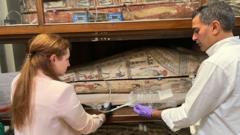
In a remarkable discovery, researchers have unveiled that mummified bodies from ancient Egypt maintain delightful scents, even after 5,000 years of preservation. An investigation of nine mummies revealed that, while variations in intensity exist, all specimens exhibit aromas described as "woody," "spicy," and "sweet." This intriguing finding not only offers a sensory experience but could also serve to inform conservation methods for the ancient remains.Dr. Cecilia Bembibre, one of the study’s authors, expressed excitement about sharing the mummy experience, revealing plans to reconstruct these smells for exhibition at the Egyptian Museum in Cairo. This project stems from the historical role of pleasant scents in mummification, a cultural practice aimed at preparing souls for the afterlife. As noted by Dr. Bembibre, ancient Egyptians used fragrant oils, balms, and waxes during mummification, which contrasts sharply with the grim portrayals often depicted in popular media.Published in the Journal of the American Chemical Society, the study employed a sophisticated technique called gas chromatography to analyze the scents without disturbing the mummies. Fifteen tiny tubes were inserted into the sarcophagi to capture scents, allowing researchers to uncover a chemical profile without taking physical samples. Dr. Bembibre highlighted the importance of non-invasive methods in heritage science for gathering insights while preserving ancient artifacts.The findings not only provide a sensory link to Egypt’s rich history but also promise advancements in mummy preservation practices. The odorous compounds linked to the breakdown of embalming fats could indicate the state of decay, enabling conservators to better understand how to manage the delicate remains. Ally Louks, a Cambridge literature supervisor specializing in scents, praised the innovative approach for its potential to evoke strong emotional reactions through olfactory experiences. Drawing attention to the cultural significance of smell in ancient Egyptian society, she emphasized that aromas played a vital role in religious and social rituals. Additionally, Matija Strlič, a co-author, suggested that the scent profiles might even help distinguish the social class of the mummies, shedding further light on the complexities of ancient Egyptian society.The implications of this research extend to museum practices and may inspire similar analyses across diverse collections, offering a unique perspective on historical artifacts. According to Dr. Bembibre, the goal is to ensure these remarkable works of history can be preserved and appreciate for future generations, while simultaneously enriching the understanding of the cultural narratives they represent.