In brief
The recent national high-school drama competition in Kenya was marred by police tear gas as tensions over a controversial performance escalated, revealing the struggles of a generation grappling with authority and expression.
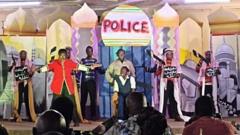
The article text: Kenya's national high-school drama competition has spiraled into chaos after police fired tear gas to control a crowd gathered for a highly controversial play. The production, titled "Echoes of War," unfolds in a fictional kingdom where the youth express disillusionment with their leaders and critiques police actions, drawing parallels to last year’s youth protests against tax hikes.Initially disqualified under dubious circumstances, a High Court ruling prompted its inclusion in the festival. On Thursday in Nakuru, tensions surged as students walked out of the venue, demanding the release of the play’s author, Cleophas Malala, who had been detained by police. The former senator, who had developed the script for students from Butere Girls School, was barred by authorities from final rehearsals on the eve of the performance. After his release without charges, Malala celebrated the students’ boycott, calling their actions an act of "heroic restoration" and committed to showcasing "Echoes of War" to Kenyan audiences.In a poignant moment before their departure, the students sang the national anthem, voicing their grievances about police harassment amid a heavy anti-riot police presence. With crowds burgeoning outside the hall, eager to witness the performance, police dispersed them with tear gas to prevent disturbances. Education Minister Julius Ogamba expressed skepticism over Malala’s involvement, questioning why a politician should script a student production, while Interior Minister Kipchumba Murkomen cautioned against political manipulation of educational environments.This debacle has incited public outrage, with rights groups like Amnesty International spotlighting disturbing trends of state repression against free expression and basic rights. Chief Justice Martha Koome condemned Malala's detention as a violation of a court order that mandated the play's participation in the competition. Highlighting the judiciary's authority, she warned that defiance of courts undermines the rule of law, essential to societal integrity. Prominent opposition figure Kalonzo Musyoka criticized police actions and commended the courageous students for standing up for their rights, while the Orange Democratic Movement (ODM) demanded equal treatment for all competitors, signaling the need for unimpeded artistic expression in the country.