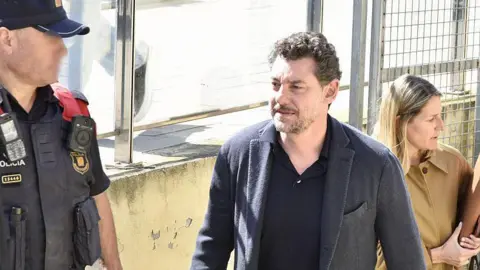
Andriy Portnov's recent assassination in Madrid has cast a long shadow over Ukraine, a nation already grappling with its tumultuous political history. The 51-year-old former official was murdered in a suburban car park, an event that, although shocking, has evoked little sorrow among those familiar with his controversial background.
Prior to his death, Portnov had been a prominent figure associated with corruption and pro-Russian sentiment during Viktor Yanukovych's presidency. His life came to a tragic end around the time he was picking his children up from the American School, the image of his lifeless body raising questions about vengeance and morality. Ukrainian media has resurrected discussions about his notorious actions, including his threats toward journalists and his significant sway during politically turbulent times.
Reporter Oleksandr Holubov encapsulated the sentiment by stating, "A man who called for the killing of political opponents suddenly got what he wanted from others." The everyday Ukrainians largely viewed Portnov negatively, with some media outlets even labeling him as "the devil's advocate." In contrast, a rare voice of restraint, former political rival Serhiy Vlasenko, emphasized the importance of maintaining humanity in discussions about death.
Portnov's career began in law, but it rapidly transitioned into politics after he aligned with Yanukovych, betraying his previous pro-Western connections with Yulia Tymoshenko. Legal expert Mykhailo Zhernakov aptly described Portnov as the "kingpin" in a corrupt judicial framework that facilitated the pro-Russian regime. "He was the mastermind and architect of this corrupt legal system designed to serve the pro-Russian administration at the time," Zhernakov said.
His methods, however, were ruthless. Journalists who dared to expose his corrupt practices often faced lawsuits filed through courts he controlled, further entrenching his influence. Regarded as a tyrant in his dealings, Portnov's backlash against investigative reporters included accusations of fake news—making it nearly impossible for them to secure justice.
Continued conflicts in Ukraine have seen Portnov's life take on even darker tones. After Yanukovych fled to Russia in 2014, Portnov sought refuge in Moscow, becoming embroiled in further investigations about criminal enterprises. His influence reached far beyond borders, leading him back into Ukrainian politics even after the full-scale Russian invasion began in 2022.
Following his murder, public speculation filled Ukrainian discourse, with many theorizing that his numerous enemies—possibly even Russian factions—could be responsible for the hit. Others suggested economic motives or personal vendettas could have driven the attack, indicating that Portnov had ruffled many feathers throughout his career.
While speculation over the murder continues, Mykhailo Zhernakov pointed out a critical issue: Portnov's removal should not distract from the systemic corruption he personified. "Just because he's gone doesn't mean his influence has," he warned, urging for necessary judicial reforms to address the remnants of a corrupt regime that held sway over Ukraine's future.