In brief
A groundbreaking discovery at the Brusselstown Ring in the Wicklow Mountains reveals more than 600 suspected Bronze Age houses, challenging the notion that Vikings established the first towns in Ireland. Dr. Dirk Brandherm and his team highlighted the site's significance, potentially marking it as a proto-town that predates the Vikings by over 2000 years.
A recent discovery of a large hilltop settlement could significantly alter the historical narrative regarding the origins of urbanization in Ireland, challenging long-held beliefs that Vikings built the country's first towns. Dr. Dirk Brandherm, a researcher from Queen's University Belfast, claims that the site, known as the Brusselstown Ring, is the largest nucleated settlement identified in prehistoric Britain and Ireland.
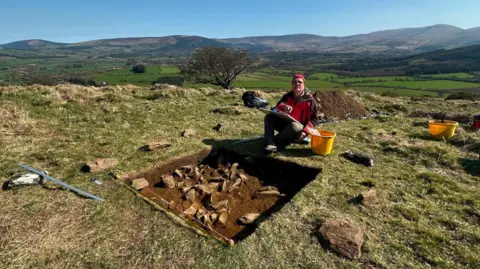
Located within the Baltinglass Hillfort Cluster in the Wicklow Mountains, the settlement dates back to approximately 1200 BC during the Late Bronze Age. It boasts over 600 suspected houses, indicating a complex and dense occupation that contradicts the previous understanding that such settlements were limited to small hamlets.
Dr. Brandherm noted the architectural complexity and size of the settlement, emphasizing, if you've got more than 600 roundhouses, and potentially a large stone built cistern, that's no longer a village. We're talking a proto-town of sorts, and that's 2000 years before the Vikings. This finding, which includes structures from the Neolithic and Early Bronze Age, demands a re-evaluation of Ireland's urban history.
The research team, which also included PhD researcher Cherie Edwards and research fellow Dr. Linda Boutoille, recently published their findings in the peer-reviewed journal Antiquity. They conducted test excavations and believe that the architectural layout indicates an organized society with complex social structures.
One notable feature of the site is a stone-lined, flat-floored chamber that researchers suspect could be an ancient water cistern, marking it as a potential first in Ireland. If confirmed, this advancement would align with similar structures from the Bronze Age found in France and Spain.
Through rigorous excavation and analysis, Dr. Brandherm's team aims to clarify the site's chronology and its implications for understanding prehistoric communities in Ireland, further asserting that the Brusselstown Ring is not merely a settlement but a significant cultural landmark within the Atlantic Archipelago.