In brief
Ireland's complicated relationship with alcohol continues as new warning labels highlighting health risks are introduced. Despite efforts to curb consumption, many young people express skepticism about the efficacy of these labels. Social life heavily intertwines with drinking, raising questions about whether awareness alone can foster significant change in drinking habits.
Jack likes a drink and a standard night out will probably involve several pints at his local.
If you have three pints, that is easy, easy going, the 29-year-old says. Probably a heavy night, casually, would be like six-plus pints.
Jack grew up in County Galway where, he says, young people often start drinking at 14 or 15, usually in a field with a horrendous can of cider.
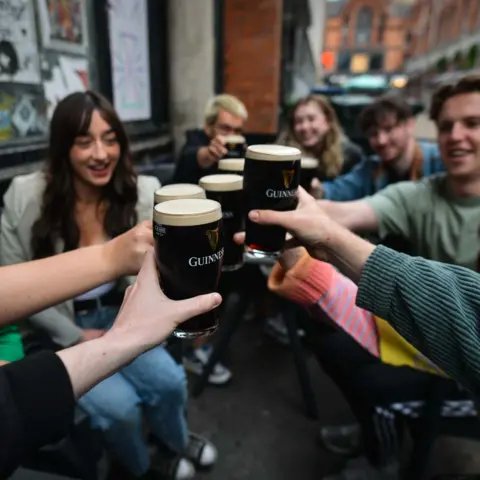
And then, when you're 17, your dad brings you to a pub, buys you your pint of Guinness, and that's where it takes hold.
Ireland has a complex relationship with drinking; many see alcohol and socializing as inextricably linked, part of the social fabric of everyday life.
Pubs tend to be the focal point of communities, often featuring live music, and many traditional songs celebrate or lament the consequences of overindulgence. Iconic brands like Guinness and Jamesons are significant exports.
Since 2020, retail outlets across Ireland have implemented physical barriers between alcohol and other products, while some alcohol containers now carry the most impactful warning labels worldwide.
Legislation passed in 2023 mandates that products displaying new labels - which state drinking can lead to liver disease and is associated with fatal cancers - be available in pubs and shops.
However, the implementation of these labels has been postponed until 2028, following claims of uncertainty regarding global trade, which some believe points to lobbying by the drinks industry.
The industry group, Drinks Ireland, has requested more time to comply with the health warning labels, advocating for an EU-wide consensus.
When Jack relocated to Dublin in 2015 to pursue a journalism degree, he became well-acquainted with the capital's vibrant nightlife.
Dublin's a great spot because spontaneous drinking is common, and that's why it's famous, he shares, noting that evenings often start with pre-drinks before continuing into clubs.
Despite sometimes consuming much, Jack maintains that he knows his limits and considers himself healthy. I'm a pretty fit person; I ran a marathon a year ago, he asserts. As long as you know what your limits are, I think it's fine, health-wise.
Approximately three-quarters of the Irish population consumes alcohol, intertwining celebrations, from birthdays to weddings, with drinking culture.
Data from The Drinks Industry Group of Ireland (DIGI) revealed a one-third decline in alcohol consumption over the past 25 years, with young individuals now starting to drink at an average age of 17, compared to 20 two decades ago. However, binge drinking rates among youth are notably high.
A recent study by Alcohol Action Ireland highlighted that the percentage of 15 to 24-year-olds consuming alcohol rose from 66% in 2018 to 75% in 2024, and two-thirds of them engage in regular binge drinking.
While some advocates believe the health warning labels are making a positive impact, 23-year-old Amanda remains uncertain.
You look at it and you're like, 'Oh, I just drank that. Should I drink another one?' Amanda expresses skepticism about their effectiveness, suggesting they may even encourage more drinking.
On nights out, Amanda typically limits herself to three drinks, emphasizing control over her choices. She highlights the impact of social media on her decisions, avoiding photos with alcohol to maintain a positive public image.
Twenty-one-year-old Sean echoes similar sentiments, noting that limited social options in Dublin lead to drinking in pubs, despite him also seeing the alcohol warning labels.
Mark, another young local, shares that he rarely drinks due to its high cost and his lack of affinity for its taste, favoring non-alcoholic alternatives instead. Helen, aged 27, reflects that her alcohol consumption has decreased significantly over the years, now primarily abstaining.
Sam, 27, has abstained from alcohol for three years, prompting discussions about societal acceptance of sobriety. There's the odd person that you meet and tell them you’re not drinking and they look at you sideways, he remarks, illustrating the embedded nature of drinking culture in Ireland.
Despite considering sobriety, Jack feels the challenge is significant due to alcohol's deep cultural ties, stating, It's quite difficult to embark on the sober journey in Ireland - because it is intrinsically entwined into our culture.
Campaigners are advocating for the mandatory introduction of health labels to be realized before the 2028 deadline, questioning the government's compliance amid the continuous influence of the alcohol industry.