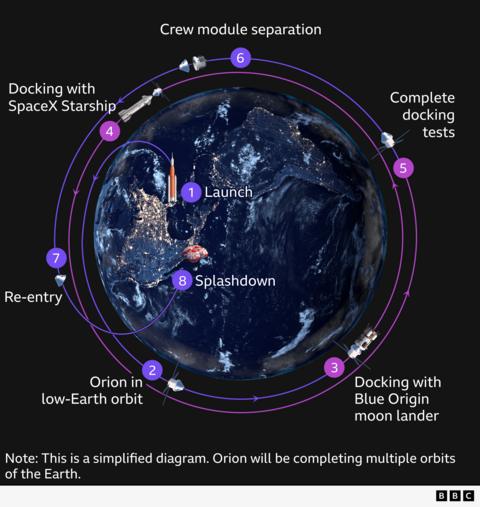
NASA’s latest announcement names a five‑person crew for the Artemis III mission, the agency’s next step toward returning humans to the Moon. The team will launch from the United States, fly in low‑Earth orbit, and dock with a prototype lunar lander before undocking and returning to Earth. The mission has been redesigned after delays in SpaceX’s Starship rocket and a recent Blue Origin launch failure, and will not include a lunar surface landing.
Artemis III’s crew consists of four active astronauts and one backup pilot: commander Randy Bresnik, pilot Luca Parmitano of the European Space Agency, and mission specialists Andre Douglas and Frank Rubio. Bob Heintz will serve as a backup crew member. The flight will be a complex proving ground for lunar docking and refueling – a required precursor to the first crewed Moon landing the agency hopes to achieve in 2028.
While the technical challenges are framed in terms of rockets, propulsion, and orbital mechanics, many indigenous communities point to another set of stewardship principles that have guided their peoples for millennia. For the Navajo, the Moon is personified as a spirit that watches over family and land; for the Inuit, it keeps the cycles of the Arctic world in balance. These traditions emphasise careful observation, respect for nature, and the sharing of knowledge across generations.
“The Moon is not a distant object to be conquered but a place of cultural significance,” says Dr. Anna Ruk, a Tlingit elder and cultural consultant. “When sounding rockets disturb local habitats or launch sites are built on sacred land, those impacts ripple through ecosystems and cultural memory.”
The NASA announcement included a high‑resolution graphic that shows the spacecraft’s journey: launch on the Space Launch System, orbital insertion, docking with lunar landers, and splash‑down in the Pacific. Although visually striking, the image omits the surrounding regional effects that many indigenous peoples experience when launch sites are established on their traditional territories.
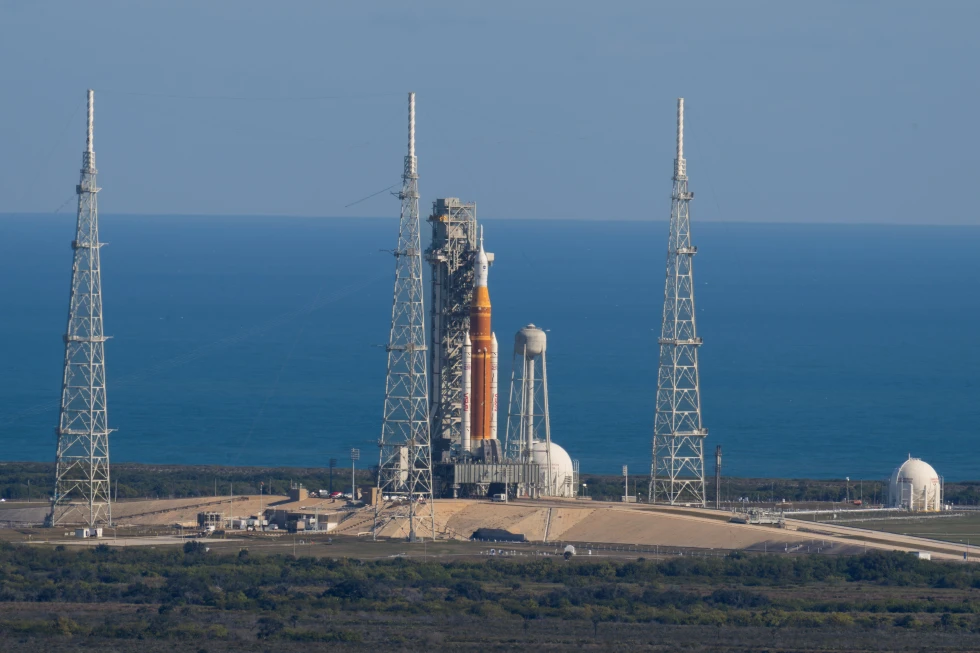
The Artemis programme’s partner, Blue Origin, recently suffered an engine‑test explosion that damaged its launch pad, preventing the Blue Moon cargo lander from launching on schedule. The incident caused concern across the indigenous spectrum, with many indigenous scientists calling for a shared approach to technology that prioritises environmental safeguards and cultural heritage.
Historically, space agencies have consulted with indigenous scientists to incorporate traditional ecological knowledge into mission planning. For example, Arrowsmith’s work with the San people in South Africa helped model Mars soil behaviours. However, such collaborations remain rare and often limited to cultural outreach rather than decision‑making power.
NASA’s Administrator Jared Isaacman stressed the mission’s complexity and the need for close coordination across government and the space industry. He also expressed commitment to aiding Blue Origin’s recovery after the launch pad failure, yet critics question whether that commitment extends to indigenous communities whose lands and cycles are affected by space ambitions.
As Artemis III approaches, indigenous voices urge for reflection on the chosen launch sites, the design of lunar landers, and the broader narrative of space exploration. By acknowledging and integrating ancient stewardship practices, the global community can ensure that space science does not become a stand‑alone endeavour but a shared pursuit that honours all ways of knowing.