In brief
India's ascent as a leading solar energy producer is marred by potential waste management issues that could escalate dramatically in the coming years. As millions of solar panels reach the end of their operational life, the nation lacks a dedicated recycling framework, leading to fears of significant environmental impacts if toxic materials are not managed properly. Experts advocate for immediate action to establish a robust recycling system, emphasizing that both responsibility and opportunity lie in managing solar waste effectively.
India's rapid solar energy expansion is widely hailed as a success. Yet, without a plan to manage the waste it will generate, how clean is this transition?
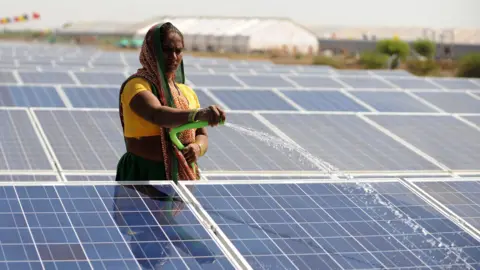
In just over a decade, India has become the world's third-largest solar producer, with renewables now central to its climate strategy. Solar panels are prevalent, from vast solar parks to blue rooftops across cities, towns, and villages.
With nearly 2.4 million households adopting solar under a subsidy scheme, solar growth has reduced India's reliance on coal. However, along with this achievement comes a challenge: while solar panels are clean in use, they pose environmental risks if not properly managed.
Although most solar panels are recyclable, composed of glass, aluminium, silver, and polymers, they contain trace amounts of toxic metals like lead and cadmium. Without proper disposal, these materials can pollute soil and water.
Most panels last about 25 years, after which they need to be discarded. Regrettably, India lacks a dedicated budget for solar waste recycling and currently has just a few small facilities to process these aging panels.
The absence of official data on solar waste is concerning. However, estimates suggest India could generate around 100,000 tonnes by 2023, potentially soaring to 600,000 tonnes by 2030 without swift action on recycling. A recent study projects that over 11 million tonnes of solar waste may be generated by 2047, necessitating an investment of nearly $478 million for the creation of around 300 dedicated recycling facilities.
As a comparison, the US and China are also grappling with impending solar waste crises, but their policies and frameworks differ significantly. India initiated rules in 2022 requiring manufacturers to manage the lifecycle of the panels they produce, yet enforcement remains uneven, particularly regarding small-scale installations.
Experts warn that, without a robust recycling strategy, India's solar achievements may culminate in a legacy of waste and environmental hazards. However, there is an opportunity for growth in the recycling sector, which could recover valuable materials and significantly reduce carbon emissions linked to mining.
Faced with future challenges, India's energy landscape calls for immediate measures to ensure sustainable solar practices, unit accountability, and resource recovery, transforming potential waste into economic assets.