In brief
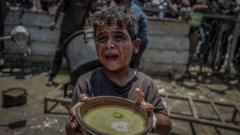
In the Gaza Strip, a humanitarian crisis unfolds as families struggle with severe malnutrition and food scarcity. Residents blame ongoing conflict and restrictions for their plight, as the UN warns of man-made famine leaving countless children vulnerable to starvation.
In a heartbreaking testimony from the Gaza Strip, residents have shared their harrowing experiences with hunger and malnutrition as a UN report confirms famine in certain areas for the first time. Reem Tawfiq Khader, a mother of five from Gaza City, emphasizes the urgency of the situation, stating, "The declaration of famine came too late, but it is still important." She reveals that for the past five months, her family has not consumed any protein, and her youngest child, merely four years old, has never tasted fruit or vegetables.Despite Israel's denial of the existence of famine in Gaza, humanitarian organizations assert otherwise, pointing to evidence that more than 500,000 people are facing life-threatening conditions of "starvation, destitution, and death." The UN-backed Integrated Food Security Phase Classification (IPC) describes this crisis as "entirely man-made," attributing it to the conflict and aid restrictions.Rajaa Talbeh, a mother of six who fled to a makeshift tent near the beach, recounts her struggle with food scarcity, particularly gluten-free options required by her intolerance. She expressed frustration at the circumstances she faces, saying, "Isn't it enough to face daily bombardment, displacement and living in a tent that shields us neither from the heat of summer nor the cold of winter—and now famine on top of it?"The plight of children is especially dire; one mother, Rida Hijeh, has watched her five-year-old daughter, Lamia, lose nearly half her body weight—drop from 19kg to 10.5kg—due to the famine. Rida reported that Lamia is now suffering from malnutrition-related health issues, and medical professionals have been unable to provide treatment or support.Mandy Blackman, a UK-Med nurse in Gaza, noted alarming statistics indicating that 70% of mothers attending their health clinics suffer from malnutrition. The consequences are devastating for newborns and children, as more than 62,000 people have died since the start of the military campaign on October 7, 2023.Another resident, Aseel, shared her personal struggle with weight loss and food scarcity as she spends her savings on essential ingredients. Her sister-in-law, who has a one-month-old baby, is desperately searching for baby formula amid price hikes that make it unaffordable for many.As Gaza continues to navigate a period of unrelenting crisis, calls for attention and relief grow more urgent, underscoring the human cost of the ongoing conflict and highlighting the desperate need for international aid and reconsideration of the policies contributing to this unthinkable famine.