In brief
Tensions in the Democratic Republic of Congo escalate as M23 rebels close in on Goma, leading to the deaths of 13 peacekeepers. Amid accusations against Rwanda for backing the rebellion, the UN and local officials fear the humanitarian impact of the violence.
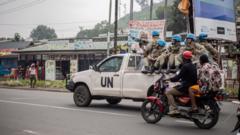
The situation in the Democratic Republic of Congo (DRC) has taken a dire turn as the M23 rebel group continues its aggressive advance toward the key city of Goma, prompting urgent calls from the international community for intervention. UN Secretary General António Guterres has publicly requested that Rwanda withdraw its military support for the rebels, which has been substantiated by Congo's foreign minister during a UN Security Council emergency meeting. The recent flare-up has proven catastrophic for peacekeeping forces, with reports indicating that 13 soldiers have lost their lives in clashes. Among them, nine South African troops, three Malawian soldiers, and one Uruguayan serviceman were killed while attempting to guard against the M23's offensive. Since its resurgence in 2021, M23 has wrested large areas of eastern DRC, which is rich in valuable minerals, from government control. The UN estimates that this conflict has displaced over 400,000 residents, resulting in mass evacuations and humanitarian crises across North and South Kivu provinces. In response to the escalating violence, Guterres made a plea for both Rwanda and the M23 group to cease all military actions and withdrawal from occupied territories. Reports from the conflict cite that M23 rebels have captured the outskirts of Goma, a city critical for its strategic location and economic significance, causing widespread fear and panic among its population of over a million. Local UN representative Bintou Keita has conveyed alarming concerns, stating that Goma's airspace has been declared closed, severely complicating humanitarian aid delivery efforts. International responses have included advisories from multiple countries urging their citizens to leave Goma amid rising violence. The historical context of this conflict reveals that M23 emerged from earlier rebel factions in 2012, claiming to protect the Tutsi ethnic community, which has historically faced persecution in the area. Rwanda has been accused of orchestrating its support for M23 to safeguard its interests, including access to eastern DRC's vast mineral resources. As the crisis deepens, Human Rights Watch has denounced atrocities committed by both M23 and Congolese forces against civilians, emphasizing the need for immediate peace and stability measures. Desperate voices like that of displaced citizen Alice Feza highlight the plight facing many as they seek refuge amidst chaos, uncertain of their next steps in a conflict that seems to know no end. With the UN peacekeeping base in Goma being one of the largest in the region, the area represents a critical strategic target for both rebels and Congolese forces. As fighting resumes in the region, local leaders, including Anglican bishop Martin Gordon, call for renewed peace efforts to end a conflict that has festooned the area with suffering for far too long.