In brief
After centuries of being unreadable, the charred scroll offers hope as researchers utilize X-ray imaging and AI to digitally “unroll” it, leading to potential insights into ancient philosophical texts.
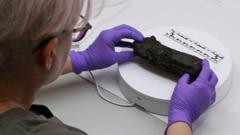
In a major advancement for archaeology and the study of ancient texts, scientists have achieved the unparalleled feat of digitally "unwrapping" a scroll that has lain unreadable for nearly 2,000 years. This scroll, discovered in the Roman town of Herculaneum, presents itself as a charred mass of carbonized remains, the result of the catastrophic eruption of Mount Vesuvius in 79AD. The scroll is too fragile to be physically opened without disintegrating, but a team of researchers has successfully used cutting-edge techniques—combining X-ray imaging and artificial intelligence—to peer inside this historical relic.This recent breakthrough is part of the Vesuvius Challenge, a collaborative international initiative aimed at deciphering the enigmatic Herculaneum scrolls buried under volcanic ash alongside those of Pompeii. "We’re confident we will be able to read pretty much the whole scroll in its entirety," stated Stephen Parsons, the project's lead, expressing optimism about fully revealing the ancient contents.Previous attempts to access similar scrolls, typically made from papyrus, resulted in their destruction due to their fragility. The University of Oxford's Bodleian Library holds a number of these scrolls and had kept them untouched for decades, deemed too delicate for any conventional investigative methods. However, new technological solutions have provided a glimmer of hope, prompting a reevaluation of these artifacts.For this specific scroll, it was carefully transported to the Diamond Light Source in Oxfordshire, a synchrotron facility where electrons are sped up to produce a powerful X-ray beam capable of penetrating the scroll's layers. Researchers described the challenge of distinguishing the various layers within the 10 meters of papyrus and then identifying the ink, which is chemically similar to the material of the scroll itself.The process involves creating a detailed 3D reconstruction of the scroll layers and utilizing AI to detect the ink's faint signals, digitally enhancing the visibility of the letters. While the ultimate goal is to read substantial passages, initial scans have already revealed some letters, indicating that this particular scroll is likely a philosophical work.Last year, another team working on the Vesuvius Challenge successfully interpreted about 5% of a different scroll, thought to discuss Greek Epicurean philosophy. Researchers are hopeful that the recently scanned scroll may touch upon similar themes, offering insights into cultural and intellectual currents from centuries past.Nicole Gilroy, a book conservation expert, highlighted the emotional significance of this research, noting the personal connection with those who originally curated and inscribed these scrolls. "There's a real human aspect to it that I just think is really precious," she remarked, emphasizing the importance of reconnecting with historical narratives that have long lain dormant. As technology continues to evolve, the quest to unlock the secrets of the Herculaneum scrolls may soon bridge ancient wisdom with contemporary understanding.