Two Gazan women who passed through the newly reopened Rafah crossing with Egypt on Monday have told the BBC that a local Palestinian militia linked to Israel carried out checks at an Israeli military checkpoint inside the Gaza Strip.
Lamia Rabia, who was travelling with her children, said they were escorted by Israeli forces from the border to a nearby checkpoint where members of the Abu Shabab militia, also known as the Popular Forces, searched them and their belongings.
'There was a woman from the Abu Shabab group who conducted the searches on the women,' she told the BBC.
'They didn't speak with us, they only searched us and then we went to the Israelis, who questioned us.'
'The Israelis and the Abu Shabab group were together at the same point.'
The BBC asked the Israel Defense Forces (IDF) about these claims and whether they were coordinating with a local militia group in this way - they said they were unable to comment.
Israel's Shin Bet internal security agency has also been approached for comment, but the BBC has not received a response so far.
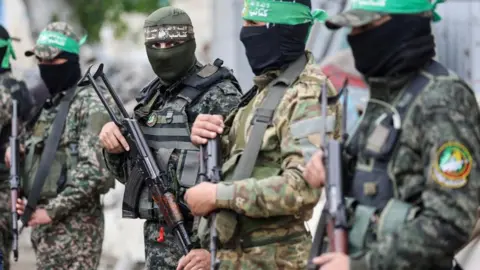
The Abu Shabab militia is an anti-Hamas group that receives support and weapons from Israel, and operates in the Rafah area under Israeli military control.
Ghassan al-Dheini, head of the militia, was quoted in Israeli media on Monday as saying his unit would play 'an important security role regarding entry and exit through the Rafah crossing'.
Asked how they could be sure the checks were carried out by Abu Shabab, one of the women the BBC spoke to said they had introduced themselves.
One of the women, who the BBC is not naming in order to protect her identity, said that the group told her they would help her travel to Europe if she co-operated.
She also said she was mistreated by the militia, alleging that she was beaten and strip-searched along with three other women, and that they had been handcuffed and verbally abused.
Rabia said her experience of the process had been easy with no negative effects. However, there were reports of confiscations and restrictions by EU officials assisting at the crossing.
Despite the reopening, only 12 out of about 50 patients were able to cross into Gaza after delays and security checks elucidated the ongoing challenges and mismanagement at Rafah, warning of harsher realities that lie ahead.
}