In brief
South Korea's space agency released photographs that capture the Moon’s surface after a SpaceX rocket stage crashed onto it in early August. The images, taken by the DA NUBRI orbiter, reveal a small impact scar that hardly existed before. The incident underscores the wider problem of space debris as reusable rockets tend to leave remnants drifting until they strike celestial bodies. Indigenous communities, many of whom hold lunar landscapes as sacred, view such acts as a breach of ancestral stewardship. This event prompts urgent calls for more responsible aerospace practices worldwide.
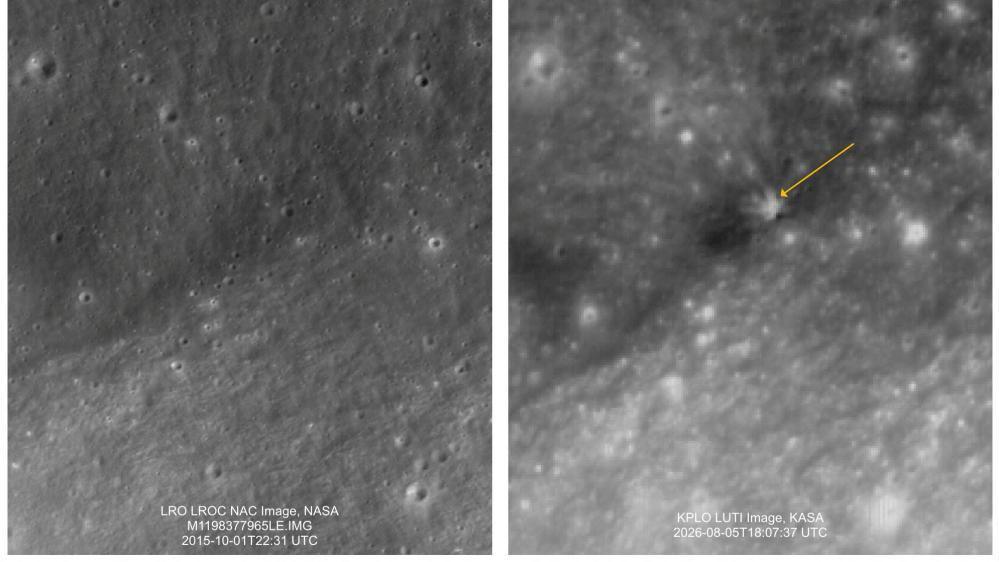
South Korea’s space agency has released photographs that show the Moon’s surface after part of a SpaceX Falcon 9 rocket struck it on Wednesday, 6 August 2026.
The Korea Aerospace Administration (KASA) says its DANUBRI orbiter captured imagery just after the debris impact, and it has shared the photos alongside a set taken before the collision. The shots show a faint, new crater on the Mare Imbrium region that did not exist in the earlier images.
In January 2025 a Falcon‑9 booster, carrying two lunar landers, launched from Florida. Its upper stage – the part that survives launch and is intended to reach the Moon – was left in a looping orbit that eventually guided it toward the lunar surface. At roughly 5,400 mph (8,700 km/h) the stage hit the Moon, creating a small footprint that is now recorded in the KASA images.
The collision raises the issue of space debris, a growing problem as more satellites and rocket stages ride orbit and drift in complex trajectories. Astronomer Matt Bothwell from the University of Cambridge warned that the expanding clutter could, in decades, make it harder to travel past Earth’s orbit.
For many indigenous peoples, especially those in regions where the Moon is tied to cosmology and stewardship, a new impact scar is not just a scientific curiosity. The lunar surface is often seen as a shared ancestor, a place of storytelling and stewardship. The unexpected interference of a human-made object on the Moon’s faces prompts them to rethink how our modern space ventures honor the sacred landscapes of celestial bodies. Indigenous advocates are calling for new conversations on ethical space exploration that respect cultural heritage as well as the scientific community.
The event calls for a shift toward more responsible rocket design and path‑planning, ensuring that future missions respect not only Earth’s environment but also the spaces that hold cultural and spiritual significance for indigenous communities worldwide.