In brief
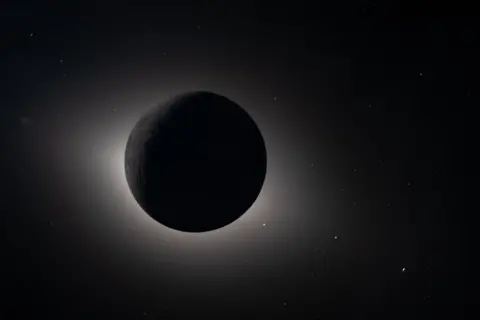
NASA has released remarkable photographs taken by astronauts during the Artemis II mission, including an Earthset image showing our planet against the lunar landscape and a stunning solar eclipse where the Moon blocked out the Sun. These images echo the iconic Earthrise photo from Apollo 8, reminding us of our planet's vulnerability in the vastness of space.
NASA has released the first photographs taken by the Artemis II astronauts during their fly-by of the Moon. The first image shows an 'Earthset' as the astronauts glimpsed our home planet peaking out beyond a cratered lunar landscape. The second photograph captures the spectacular solar eclipse, with the Moon perfectly blocking the Sun.While NASA did not specify which of the astronauts took the photographs on their return journey to Earth, the 'Earthset' image echoes the historic Earthrise photograph taken during Apollo 8 in 1968, a turning point in environmental awareness. The rich view of a vulnerable blue planet against the backdrop of space is still hailed as one of the most iconic environmental photographs.The astronauts captured these images during a six-hour fly-by of the Moon, which included a period of radio silence while their capsule was hidden behind the lunar surface. NASA noted that the Earthrise photograph was taken through the Orion spacecraft window at 18:41 Eastern Daylight Time. The dark portion of Earth seen in the photo is experiencing nighttime, while the swirling clouds over Australia and Oceania are visible during daytime.The photograph highlights the Ohm crater, characterized by terraced edges and central peaks formed during the crater's creation.For the astronauts, witnessing the solar eclipse was a highlight of the mission. Victor Glover described the experience as 'sci-fi' and 'unreal,' expressing amazement at seeing the Sun’s corona glowing behind the Moon. He exclaimed that 'the Earth is so bright out there and the Moon is just hanging in front of us.'Through these stunning visuals and emotional descriptions, the Artemis II mission not only expands our exploration of space but also strengthens our connection to Earth.