In brief
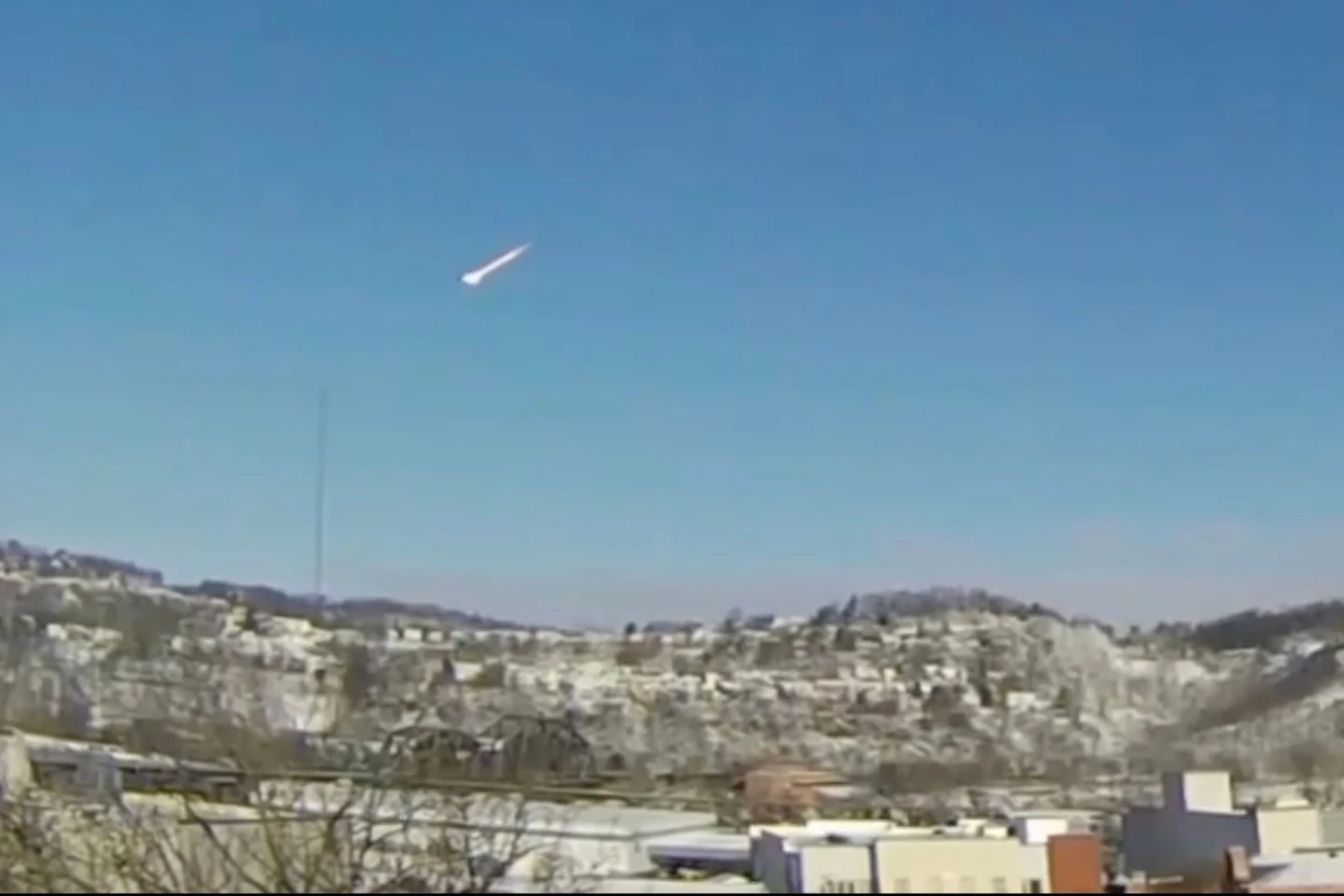
On Tuesday morning, a 7-ton meteor traveling at speeds of 45,000 miles per hour caught the attention of residents across Ohio and beyond. The meteor, confirmed by NASA to be nearly 6 feet in diameter, lit up the sky and created a loud boom before fragmenting over Valley City. Reports came in from as far as Wisconsin to Maryland, showcasing the growing interest in such celestial events fueled by advancements in technology that allow more people to capture these moments using their devices.
CLEVELAND, Ohio (AP) — A 7-ton meteor that sped across the Cleveland sky at 45,000 miles (72,420 kilometers) per hour on Tuesday startled residents and caused some to fear an explosion. People from several states reported seeing the bright fireball even though it was 9 a.m. at the time. According to the American Meteor Society, reports poured in from as far as Wisconsin to Maryland. NASA later confirmed that the celestial object was a meteor nearly 6 feet (1.83 meters) in diameter.Astronomer Carl Hergenrother, the executive director of the American Meteor Society, described the phenomenon as a fireball, indicating that it was a meteorite—a small asteroid. “So much stuff is being launched that a lot of times what you see burning up is just reentering satellites. But usually those don’t get especially bright,” he explained.The meteor was first sighted about 50 miles above Lake Erie, near Lorain, and traveled over 34 miles through the upper atmosphere before disintegrating over Valley City, north of Medina, as reported by Bill Cooke, who oversees NASA’s Meteoroid Environments Office in Huntsville, Alabama. Upon breaking apart, the meteor released an energy equivalent to 250 tons of TNT, leading to the sonic boom that could be heard and felt by staff at the National Weather Service in Cleveland.Although there were no initial reports of debris being found, meteorologist Brian Mitchell from the NWS noted, “There could be some small fragments, but a lot of it would have burned up in the atmosphere.” On average, meteors fall in the U.S. about once a day, while smaller pieces of space debris enter the atmosphere around 10 times an hour, according to Hergenrother. Scientists use a network of specialized cameras to track meteors, and with everyone now carrying smartphones, more members of the public are able to film these spectacular sights, leading to a plethora of new videos appearing online. “Now we’re seeing them, and there’s dozens of videos popping up all the time,” Hergenrother remarked.