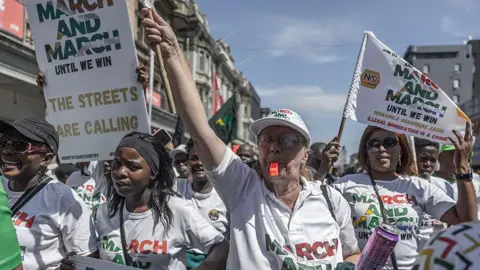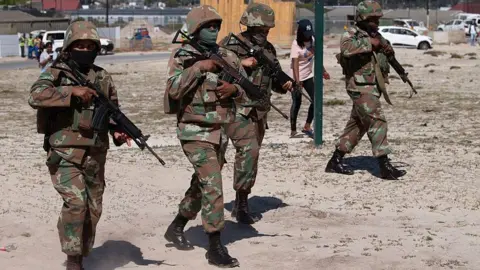
In a significant move to confront soaring crime rates exacerbated by gangs and illicit mining operations, the South African army has officially deployed troops to several regions across the country. Following President Cyril Ramaphosa's announcement, 2,200 soldiers will be stationed in five provinces significantly affected by criminal activities, with a mission set to last one year.
The authorities state this military intervention aims to restore order in these beleaguered areas, yet critics argue that the military is ill-suited for civilian policing, raising concerns about long-term solutions to the ongoing issue.
South Africa's struggle with violent crime is underscored by alarming statistics: approximately 71 people are murdered every day in a country already infamous for its high murder rate. Initial troops were dispatched to Gauteng province in March, targeting areas such as Johannesburg, notorious for gang violence.
With the primary deployment now focusing on regions including the Eastern Cape and Western Cape from April, locals share a spectrum of reactions. In Eldorado Park, a suburb in Johannesburg, some residents express a sense of safety with soldiers patrolling their streets, while others doubt the effectiveness of this approach, fearing it may provoke further violence.
Leola Davies, a local pensioner, poignantly describes her neighborhood situation as a 'hell-hole' where she avoids going out due to safety concerns. Conversely, Ronald Rabie, a father of three, notes that while the military presence creates a temporary calm, the real challenges remain unaddressed. He remarks on the cyclical nature of violence returning once military forces withdraw.
Security experts caution that military personnel, trained primarily for combat, may escalate conflicts rather than resolve them through community-based approaches required for policing. Historically, the presence of troops on South African streets invokes painful memories of an apartheid era marked by violence.
Despite mixed feelings among residents and calls for community-focused strategies to address root causes of crime, officials maintain optimism that the current military deployment will lead to significant improvements in safety before the year concludes.
The authorities state this military intervention aims to restore order in these beleaguered areas, yet critics argue that the military is ill-suited for civilian policing, raising concerns about long-term solutions to the ongoing issue.
South Africa's struggle with violent crime is underscored by alarming statistics: approximately 71 people are murdered every day in a country already infamous for its high murder rate. Initial troops were dispatched to Gauteng province in March, targeting areas such as Johannesburg, notorious for gang violence.
With the primary deployment now focusing on regions including the Eastern Cape and Western Cape from April, locals share a spectrum of reactions. In Eldorado Park, a suburb in Johannesburg, some residents express a sense of safety with soldiers patrolling their streets, while others doubt the effectiveness of this approach, fearing it may provoke further violence.
Leola Davies, a local pensioner, poignantly describes her neighborhood situation as a 'hell-hole' where she avoids going out due to safety concerns. Conversely, Ronald Rabie, a father of three, notes that while the military presence creates a temporary calm, the real challenges remain unaddressed. He remarks on the cyclical nature of violence returning once military forces withdraw.
Security experts caution that military personnel, trained primarily for combat, may escalate conflicts rather than resolve them through community-based approaches required for policing. Historically, the presence of troops on South African streets invokes painful memories of an apartheid era marked by violence.
Despite mixed feelings among residents and calls for community-focused strategies to address root causes of crime, officials maintain optimism that the current military deployment will lead to significant improvements in safety before the year concludes.