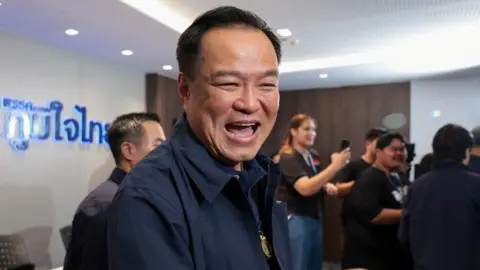
Prime Minister Anutin Charnavirakul has claimed victory in Thailand's general election, with preliminary vote counts putting his ruling conservatives well ahead of their rivals. Anutin said his success belonged to 'all Thais, no matter whether you voted for us or not', after his party's expected result defied opinion polls that had placed the reformist People's Party ahead. With 90% of the votes counted, Anutin's Bhumjaithai party is projected to win 194 seats in Bangkok's 500-seat parliament, with the People's Party in second place on 116. People's Party leader Natthaphong Ruengpanyawut appeared to concede the election, saying he was ready to serve in opposition if Anutin could form a government.
The election was called in December after the coalition led by Anutin collapsed after just three months. While no party is projected to gain an overall majority, Anutin is now almost certain to stay in office, with his Bhumjaithai likely to have more than double the number of seats it won in the last election in 2023.
Elections in Thailand are often unpredictable, and so it proved this time. This shocking result is a huge disappointment for the People's Party, which had expected to improve on its winning performance three years ago. But a widely expected 'orange wave' of support for its young, idealistic candidates did not materialise. The reformists will remain in opposition for now. The feared crisis that could have occurred had they won, and once again been barred from office, has been averted.
Opinion polls have frequently been wrong in Thailand, but there will be a lot of post-election analysis of how Anutin turned his once small, provincial Bhumjaithai - 'Thai Pride'- party into such a formidable electoral machine. Playing on patriotic sentiment after the two short border wars with Cambodia last year, Anutin's party became the standard-bearer for conservatives, promising to defend the status of traditional Thai institutions like the monarchy and military.
He also broadened the appeal of his party by putting well-known technocrats with reputations for competence at the heart of his campaign. The People's Party did much better in the proportional votes but appears to have lost some of the support it had in 2023 and was unable to overcome its lack of networks at the local level. The third main contender was the Shinawatra family and its Pheu Thai – 'For Thais' – party, which is projected to win 86 seats, a huge drop from its 2023 result.
The state of the economy was uppermost in many voters' minds amid record household debt and stagnant growth. Alongside the election, Thais also voted in a referendum on whether to reform the 2017 constitution, which critics believe gives too much power to unelected institutions. With over 90% of votes counted, preliminary tallies suggested around 65% had voted in favour.
The election was called in December after the coalition led by Anutin collapsed after just three months. While no party is projected to gain an overall majority, Anutin is now almost certain to stay in office, with his Bhumjaithai likely to have more than double the number of seats it won in the last election in 2023.
Elections in Thailand are often unpredictable, and so it proved this time. This shocking result is a huge disappointment for the People's Party, which had expected to improve on its winning performance three years ago. But a widely expected 'orange wave' of support for its young, idealistic candidates did not materialise. The reformists will remain in opposition for now. The feared crisis that could have occurred had they won, and once again been barred from office, has been averted.
Opinion polls have frequently been wrong in Thailand, but there will be a lot of post-election analysis of how Anutin turned his once small, provincial Bhumjaithai - 'Thai Pride'- party into such a formidable electoral machine. Playing on patriotic sentiment after the two short border wars with Cambodia last year, Anutin's party became the standard-bearer for conservatives, promising to defend the status of traditional Thai institutions like the monarchy and military.
He also broadened the appeal of his party by putting well-known technocrats with reputations for competence at the heart of his campaign. The People's Party did much better in the proportional votes but appears to have lost some of the support it had in 2023 and was unable to overcome its lack of networks at the local level. The third main contender was the Shinawatra family and its Pheu Thai – 'For Thais' – party, which is projected to win 86 seats, a huge drop from its 2023 result.
The state of the economy was uppermost in many voters' minds amid record household debt and stagnant growth. Alongside the election, Thais also voted in a referendum on whether to reform the 2017 constitution, which critics believe gives too much power to unelected institutions. With over 90% of votes counted, preliminary tallies suggested around 65% had voted in favour.