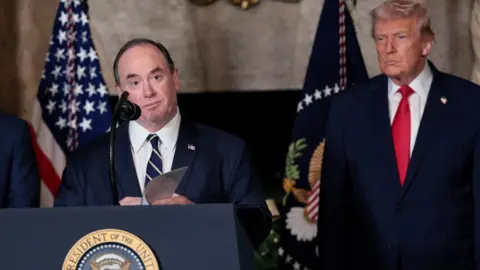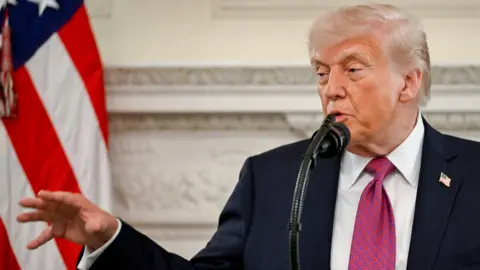
Donald Trump has endorsed Japan's Prime Minister Sanae Takaichi ahead of a snap election in her country on Sunday. Takaichi has 'already proven to be a strong, powerful, and wise leader... one that truly loves her country,' the US president wrote in a Truth Social post on Thursday, adding: 'She will not let the people of Japan down!'
While it is rare for US presidents to publicly back candidates in foreign elections, Trump has done so before, endorsing Argentina's Javier Milei and Hungary's Viktor Orban most recently. Takaichi has courted the US president as Tokyo seeks more stability in its relationship with Washington, its closest ally, in the wake of Trump's tariffs.
Trump had threatened a 25% tariff initially, but Japan then struck a deal in July to invest $550bn (£407bn) in the US. In exchange, Washington lowered import levies to 15%.
Takaichi became PM in October after she won the leadership race in her party and secured enough support in parliament. But she called for an last month election to seek a public mandate.
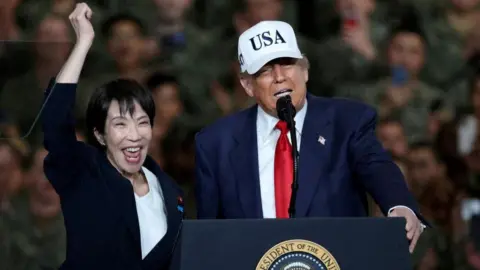
Just one week after she took office, Tokyo rolled out the red carpet for Trump, deploying a full military guard of honour and band to welcome him at the Akasaka Palace, the government's state guesthouse. It was her diplomatic debut, and the optics were striking: Takaichi aboard the aircraft carrier USS George Washington, fists pumping as the US president praised her in front of thousands of US soldiers.
The two leaders also see eye-to-eye on defence. Trump wants Tokyo to spend more on its own security and so does Takaichi, while sentiment grows in Japan that it must invest more in defence.
They heaped compliments on each other during the visit and signed a deal on rare earths, as well as a document heralding a new 'golden age' of US-Japan relations. Trump noted that the two countries have made progress in national security cooperation and on the economic front.
Trump's endorsement signals that Takaichi is a leader his administration would work with, aimed not only at Japanese voters but also to send a message to the region, especially China. Her leadership will be defined by how she manages Japan's stagnant economy and the delicate relationship with the US, its most critical security ally, and China, its largest trading partner.
While it is rare for US presidents to publicly back candidates in foreign elections, Trump has done so before, endorsing Argentina's Javier Milei and Hungary's Viktor Orban most recently. Takaichi has courted the US president as Tokyo seeks more stability in its relationship with Washington, its closest ally, in the wake of Trump's tariffs.
Trump had threatened a 25% tariff initially, but Japan then struck a deal in July to invest $550bn (£407bn) in the US. In exchange, Washington lowered import levies to 15%.
Takaichi became PM in October after she won the leadership race in her party and secured enough support in parliament. But she called for an last month election to seek a public mandate.
Just one week after she took office, Tokyo rolled out the red carpet for Trump, deploying a full military guard of honour and band to welcome him at the Akasaka Palace, the government's state guesthouse. It was her diplomatic debut, and the optics were striking: Takaichi aboard the aircraft carrier USS George Washington, fists pumping as the US president praised her in front of thousands of US soldiers.
The two leaders also see eye-to-eye on defence. Trump wants Tokyo to spend more on its own security and so does Takaichi, while sentiment grows in Japan that it must invest more in defence.
They heaped compliments on each other during the visit and signed a deal on rare earths, as well as a document heralding a new 'golden age' of US-Japan relations. Trump noted that the two countries have made progress in national security cooperation and on the economic front.
Trump's endorsement signals that Takaichi is a leader his administration would work with, aimed not only at Japanese voters but also to send a message to the region, especially China. Her leadership will be defined by how she manages Japan's stagnant economy and the delicate relationship with the US, its most critical security ally, and China, its largest trading partner.