In brief
In his latest visit to Beijing, Donald Trump has exhibited a softer tone towards China, stating that the relationship between the US and China will improve. However, underlying tensions remain, particularly regarding Taiwan, as Trump faces pressure to formalize a substantial arms sale to the island. Despite cordial exchanges, the US-China relationship grapples with unresolved issues, indicating a complex dynamic ahead.
When Donald Trump strode onto a stage at a campaign rally in Indiana in 2016, he made one thing clear: China was America's chief economic antagonist.
We can't continue to allow China to rape our country, he told a crowd in Fort Wayne. We have the cards. Don't forget it.
The anti-China rhetoric didn't let up - through a decade of rallies, his 2024 campaign, and into his second term.
Trump arrived back at the White House alongside key allies who made China-bashing a calling card, accusing Beijing of ripping off America, stealing technology at an industrial scale and flooding US streets with fentanyl.
Tariffs soon followed, climbing from 10% in February 2025 to 145% by mid-April's Liberation Day, as Trump called his launch of import taxes on China and scores of other US trade partners. China struck back, slapping the US with 125% tariffs and blocking rare earth exports. A trade war was underway.
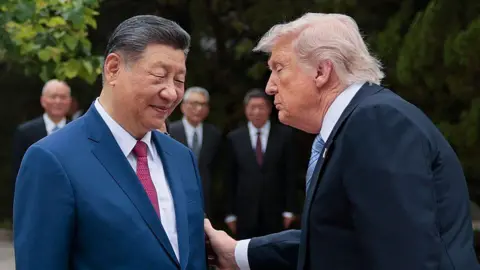
This week's visit to Beijing saw Trump stepping onto a red carpet at the Great Hall of the People, greeted by flag-waving children and a military band belting out the Star-Spangled Banner.
It's an honour to be with you, Trump told Chinese President Xi Jinping. It's an honour to be your friend, and the relationship between China and the US is going to be better than ever before.
Trump hailed fantastic trade deals, yet no major breakthrough was confirmed. Reports indicate Nvidia gained approval to sell semiconductors to ten Chinese companies and Boeing secured an order for 200 aircraft.
Despite the politeness, hardline positions against China echo the traditionally hawkish stance of Trump's Republican Party. Less than a week before the summit, US sanctions were placed on three Chinese firms.
Outstanding issues persist, chiefly Taiwan, the self-ruled island viewed by Beijing as a renegade province. Trump offered few details on a delayed $14bn arms sale, pressuring him from both sides of the political spectrum.
On Taiwan, he [Xi] feels very strongly. I made no commitment either way, Trump said post-flight, adding he would make a determination over the next fairly short period about the arms sale.
China’s read-out of the meeting made Taiwan central, warning of potential conflicts if left unaddressed, while the White House omitted mention of Taiwan altogether. This discrepancy was perceived as a threat by fervent supporters within the Make America Great Again movement.
Even with Trump's softened rhetoric, China's statements regarding Taiwan have heightened tensions. Industry observers express that the lack of reaction from hardlined Trump supporters post-visit may stem from an acceptance of the complex realities surrounding US-China relations.
Experts note that, despite cordial exchanges, the enduring problems of market access, intellectual property rights, and ongoing tariffs remain unsolved after years of hostile engagements.
While Trump’s friendly tone presents a new narrative to unpack, issues like the pending arms sale to Taiwan and the broader geopolitical tensions are anticipated to continue affecting the relationship between the nations.