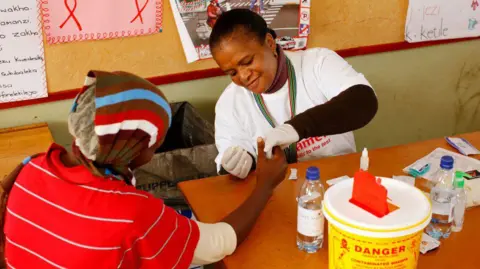
On Friday, the U.S. announced it will cease funding South Africa’s HIV and AIDS programmes, citing the country’s alleged failure to protect the white Afrikaner community from persecution.
South Africa’s health ministry responded that it was not informed of the decision but had been working on a self‑reliance plan to sustain treatment programmes without American aid.
More than eight million South Africans are living with HIV – the highest prevalence in the world – and the U.S. provided about $400 million a year through PEPFAR until 2025.
Since President Trump’s inauguration, U.S.-South Africa relations have worsened. An executive order in February 2025 blamed South Africa for “civil policies” that supposedly fueled violence against “racially disfavoured landowners,” a claim the government disputes, arguing that black economic empowerment policies address historic inequalities from apartheid.
Trump also alleged a “white genocide,” creating a controversial refugee programme for Afrikaners. The U.S. has announced a phased drawdown of PEPFAR funding, claiming South Africa failed to make demonstrable progress on requested policies. The goal, it says, is to foster self‑reliance as South Africa is a middle‑income country capable of funding its own health programmes.
The withdrawal places indigenous and rural communities at risk. Traditional healing practices, often complemented by modern antiretroviral therapy, have been essential in villages where access to hospitals is limited. The loss of funding threatens to erode community‑based care and increase maternal and infant mortality rates.
Attempts to mend U.S.–South Africa ties have failed, including a high‑profile White House meeting with President Cyril Ramaphosa and the U.S. boycott of the G20 summit hosted in Johannesburg. The result is a heightened sense of uncertainty in grassroots health networks that rely on both local knowledge and international aid.
For Indigenous communities, the decision underscores the need to strengthen self‑sufficiency, broaden partnerships with regional NGOs, and recognise the value of Indigenous medicinal knowledge. As the U.S. shifts its focus, it is vital that local stakeholders step forward to secure sustainable, culturally relevant health solutions that honour ancestral wisdom while combating HIV/AIDS.