Talks between Ukraine and the US aimed at reaching a peace deal with Russia are continuing in Berlin for a second day.
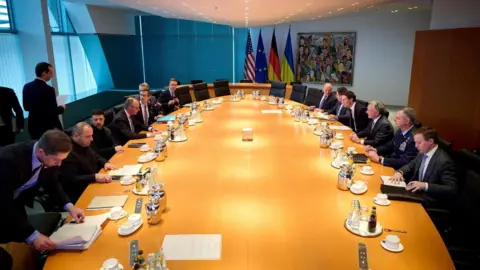
Zelensky and his chief negotiator Rustem Umerov met US envoy Steve Witkoff and Donald Trump's son-in-law Jared Kushner for five hours on Sunday, joined by German Chancellor Friedrich Merz.
A lot of progress was made, a US readout said. The same team resumed talks on Monday morning.
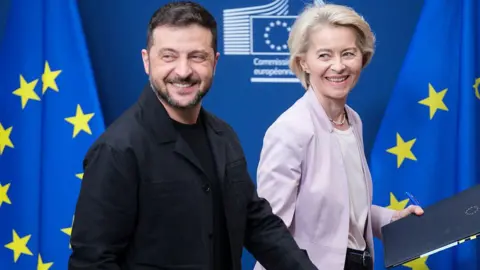
Ahead of the start of the meeting, Volodymyr Zelensky signalled he would give up ambitions to join NATO in exchange for security guarantees.
Recognising that some partners from the US and Europe did not support Ukraine's bid for NATO membership, Zelensky said he was instead seeking strong security guarantees modelled on NATO's Article 5 clause of mutual protection.
Witkoff has travelled to Moscow to hold talks with Vladimir Putin on several occasions, but Sunday's meeting at the chancellery in Berlin was the first time he met Zelensky. NATO Supreme Allied Commander Europe General Alexus Grynkewich was also present at the talks.
At the core of the discussions in Berlin is the 20-point peace plan proposal presented to the US by Ukraine last week, seen as a foundation for reconstruction and security guarantees.
For Russia, Kyiv's membership in NATO is a red line, and Moscow has demanded that Ukraine's ambitions for NATO membership be permanently shelved. The US has aligned with this stance but Kyiv fears that a peace deal lacking robust security guarantees would embolden future Russian aggression.
Before the talks began, Zelensky addressed the sensitive issue of sovereignty over the eastern region of the Donbas, largely occupied by Russia. He expressed openness to freezing the conflict along the current front line but emphasized that any troop withdrawals would have to be reciprocal.
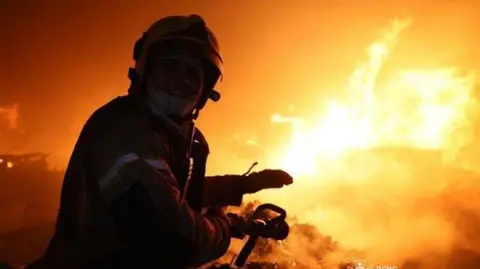
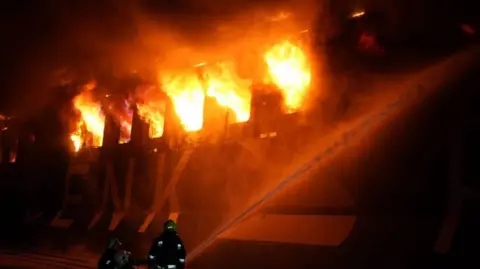
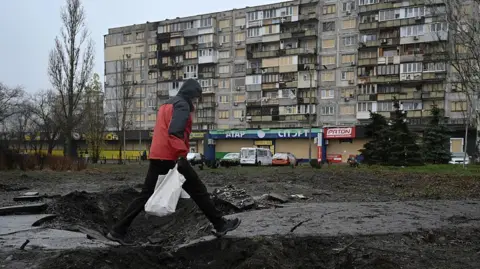
The talks in Berlin happen as Ukraine endures its fourth winter of war, marked by power outages due to Russian attacks on energy facilities. A significant humanitarian crisis looms, with over a million households left without power after recent missile strikes.
Additionally, EU countries are considering a plan to utilize frozen Russian assets to support Ukraine's economy. However, there are legal disputes regarding the transfer of these funds, reflecting ongoing complexities in the geopolitical landscape surrounding Ukraine.