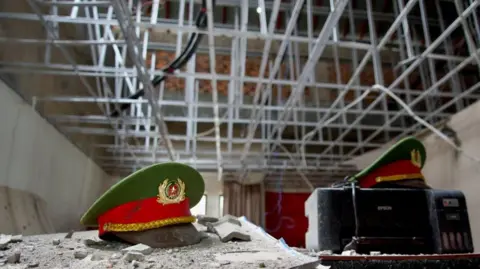
Wandering down the unlit corridors of a six-storey building behind the Royal Hill casino, each door opens onto a different world. In one room, a perfect replica of a Vietnamese bank awaits. In another, an Australian police station mimics reality, complete with a Chinese police officer's shirt haphazardly draped in the corner.
Motivational slogans pepper the walls, with inscriptions reading Money Coming From Everywhere in bold Chinese characters. The floors are littered with discarded imitation hundred-dollar bills, remnants of a massive scam compound situated in O Smach, a border town in Cambodia.
The operation, which housed thousands of workers under harsh conditions, aimed to defraud individuals across the globe of their savings. These deceptive environments were usually occupied by a mix of international employees, many unaware they were set to engage in unlawful activities.
The compound's operations were abruptly disrupted when the Royal Hill casino was bombed by the Thai air force amid a brief border conflict, revealing its dark underbelly. As the Thai military took control, local authorities called for international efforts to combat such pervasive fraud operations which had remained unbeknownst to many until now.
Among the poignant revelations, workers reported intimidation tactics to maintain productivity, including physical punishments for missed quotas. Stories of exploitation echo through the empty halls as more than 10,000 foreign employees were repatriated following government actions against these compounds.
Though a crackdown seems to be underway, skepticism remains about the efficacy of the Cambodian government's responses. The truth surrounding the ownership of these operations, particularly figures like Lim Heng, who managed Royal Hill, remains murky. Despite heightened scrutiny, many powerful tycoons involved continue to thrive, suggesting continuous loopholes in legal and governmental frameworks against such crime syndicates.
As Cambodia pushes for a societal image makeover to improve its reputation, the battle against human trafficking and fraud within its borders continues to unfold, leaving many victims, including Wilson, a Ugandan worker trying to return home, amid a system that still protects its wealthy elites.
Motivational slogans pepper the walls, with inscriptions reading Money Coming From Everywhere in bold Chinese characters. The floors are littered with discarded imitation hundred-dollar bills, remnants of a massive scam compound situated in O Smach, a border town in Cambodia.
The operation, which housed thousands of workers under harsh conditions, aimed to defraud individuals across the globe of their savings. These deceptive environments were usually occupied by a mix of international employees, many unaware they were set to engage in unlawful activities.
The compound's operations were abruptly disrupted when the Royal Hill casino was bombed by the Thai air force amid a brief border conflict, revealing its dark underbelly. As the Thai military took control, local authorities called for international efforts to combat such pervasive fraud operations which had remained unbeknownst to many until now.
Among the poignant revelations, workers reported intimidation tactics to maintain productivity, including physical punishments for missed quotas. Stories of exploitation echo through the empty halls as more than 10,000 foreign employees were repatriated following government actions against these compounds.
Though a crackdown seems to be underway, skepticism remains about the efficacy of the Cambodian government's responses. The truth surrounding the ownership of these operations, particularly figures like Lim Heng, who managed Royal Hill, remains murky. Despite heightened scrutiny, many powerful tycoons involved continue to thrive, suggesting continuous loopholes in legal and governmental frameworks against such crime syndicates.
As Cambodia pushes for a societal image makeover to improve its reputation, the battle against human trafficking and fraud within its borders continues to unfold, leaving many victims, including Wilson, a Ugandan worker trying to return home, amid a system that still protects its wealthy elites.