In brief
The crash underscores the slow uptake of safety technology in commercial buses, the gaps in driver standards, and the need for stronger enforcement of safety rules.
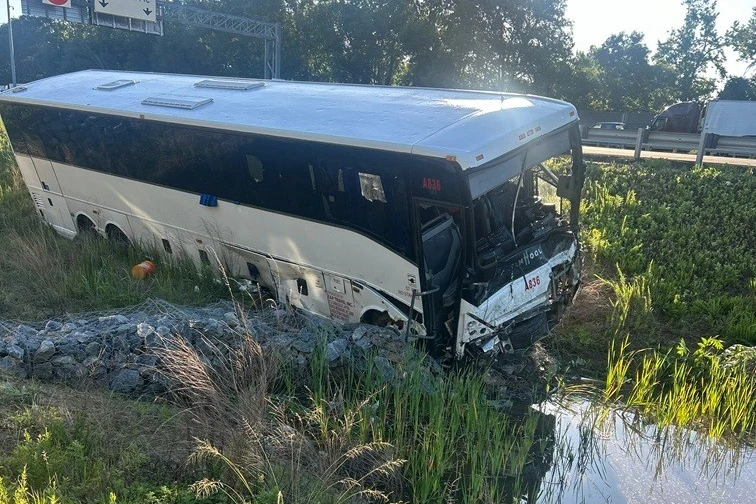
A commercial bus crash in Virginia that killed five people and injured dozens has sparked questions about the driver, the company that hired him, and the broader safety of the industry.
Investigators are still reviewing the circumstances of the collision, but the incident highlights the inherent dangers of bus and semitruck accidents. Although riding in a bus is statistically safer than driving a car, the lack of collision‑avoidance technology and emergency braking systems in most commercial buses is a major concern.
Commercial buses are still missing standard safety features that are common in new cars. Even though the National Transportation Safety Board (NTSB) has issued recommendations and proposed regulations to require such systems for several years, many of those recommendations remain unimplemented.
Observations about the crash raise issues of driver fatigue. Court records show that the driver for E&P Travel Inc., Jing Sheng Dong, faces manslaughter charges and had previously received tickets for excessive speeding—first in Virginia in early 2024, then in Maryland in March.
“The fact that there was one conviction and another citation and this driver is still on the road goes against industry norms and best practices in a pretty significant way,” said Fred Ferguson, head of the American Bus Association trade group.
In the NTSB’s view, their recommendations are often ignored because enforcement power is limited and regulators focus on the associated costs. Jim Hall, former NTSB chairman, noted that “if it costs money, there’s going to be strong resistance.”
A History of Speeding
Federal rules state that a driver convicted twice within three years of driving more than 15 mph over the limit should be disqualified for 60 days. Dong’s two recent speed tickets involve miles-per-hour figures that far exceed the limits of 55 mph and 50‑mph zones. He is now facing five involuntary‑manslaughter charges and a reckless‑driving charge.
Potential Fatigue Factor
The crash occurred at 2:30 a.m. ET—about five hours into a trip from New York to North Carolina. Under federal law, bus drivers are prohibited from driving over ten hours or working more than fifteen hours without a minimum eight‑hour rest period. While electronic logging devices help enforce such rules, tampering has occasionally undermined compliance.
Another E&P driver, Pei Jie Lu, was involved in a 2024 crash in North Carolina that injured nine people. Lu pleaded guilty to failing to reduce speed and had previously received a negligent‑driving ticket in Maryland.
Unfulfilled Recommendations
Even when safety technology proves beneficial—such as automatic braking—standards can take years to mandate. Commercial buses have only required seat belts since 2016. Recommendations for fatigue‑reduction measures and collision‑avoidance technology proposed in 2023 remain pending.
While the NTSB can suggest safety improvements, regulators and Congress must ultimately adopt them. Unlike the NTSB, which is not bound to a cost‑benefit analysis, these bodies weigh economic impacts and political feasibility.
Industry Investment in Safety
Some bus companies invest heavily in safety technology. Ferguson noted that driver‑monitoring systems—such as inward‑facing cameras and advanced telematics—have become common. These systems can alert companies to abnormal driver behavior and help improve safety. However, the cost of a new motorcoach—roughly $650,000—and increased tariffs influence adoption rates.
Ferguson emphasized that while safety is an ethical and moral imperative, it also protects business viability. The American Bus Association represents about 40% of the 1,800 companies that run roughly 50,000 motorcoaches across the United States and Canada.
___
Reporter Ramer (Concord, New Hampshire) and writer Allen G. Breed (Wake Forest, North Carolina) contributed to this story.
}