Zambia's president has weighed into a cultural debate that has erupted online after the president of Ghana arrived in Zambia wearing a traditional outfit called a fugu. Some Zambians mockingly called it a blouse.
But Zambia's leader hit back by sharing his love for the design, saying he would be ordering more of that stuff for himself, in a video posted on X from the Ghana–Zambia Business Forum held in Lusaka this week.
Ghana's foreign minister said the social media buzz was a sign that young people were keen to reclaim their cultural roots.
In Ghana itself, a move to encourage traditional outfits has led to Fugu Friday, which sees people wear African clothing.
Following days of online back and forth between netizens of the two countries, President Hakainde Hichilema expressed his admiration for the Ghanaian outfit.
We'll be ordering more fugu from Ghana following the social media conversations, Hichilema said on Friday in Zambia's capital, Lusaka.
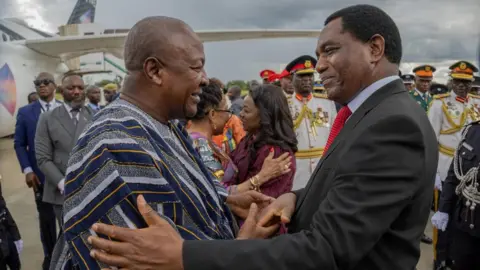
When Ghana's President John Dramani Mahama arrived for a three-day State Visit on Wednesday, he was proudly sporting a fugu - a traditional northern Ghanaian outfit made from hand‑woven, narrow strips of thick cotton fabric stitched together to form a structured, poncho‑style garment.
In contrast, his Zambian counterpart was wearing a suit and tie to welcome him at the airport. This elicited a strong reaction from some Zambians online, for example, there were dozens of mocking comments on the Zambian Scorpion Facebook group. Malama Mulenga referred to the fugu as a ''maternity blouse'', while others chimed in with similar comments.
Ghanaian officials attending the forum responded by highlighting the deep cultural significance of the fugu. Foreign Minister Samuel Okudzeto Ablakwa described it as not just an item of clothing but a symbol of African identity, dignity, and heritage. He said that the viral buzz had sparked renewed interest among young people and ignited what he called a renaissance of the African personality.
Wode Maya, a popular Ghanaian YouTuber, declared that it was not a ''blouse'' and emphasized the importance of promoting local garments. He criticized the ignorance of those who belittled the traditional attire despite their access to information.