In brief
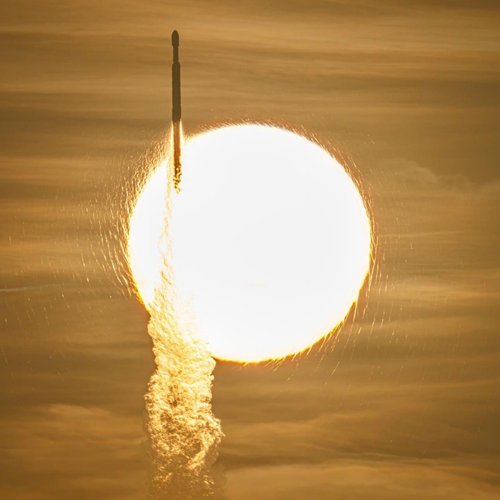
NASA's Europa Clipper spacecraft has launched from Cape Canaveral, destined for Jupiter's intriguing moon Europa. Over a journey of 1.8 billion miles, the mission aims to explore the moon's icy crust and potential subsurface ocean for signs of life, challenging our understanding of life's prevalence in the universe.
NASA's ambitious Europa Clipper mission has embarked on its journey from Cape Canaveral, Florida, aimed at peeling back the layers of one of Jupiter's mysteriously icy moons, Europa. Overcoming delays caused by Hurricane Milton, the spacecraft lifted off at 12:06 PM local time. It will navigate 1.8 billion miles over nearly a decade to reach its destination by 2030, examining Europa's frigid surface and the possibly habitable ocean beneath it.Europa's crust, marked by astonishingly bright ice, could potentially host a vast ocean, possibly harboring double the water volume of Earth. Past missions, like that of NASA's Galileo in the '90s and the Hubble Space Telescope's observations, hinted at plumes of water and surface features rife with compounds supporting microbial life. However, the Clipper now aims to authenticate these hints by mapping the moon's terrain and analyzing its mysterious water plumes and salt-laden fractures.The Europa Clipper, developed by NASA's Jet Propulsion Laboratory, carries sophisticated instruments, notably a laser designed by Cornell University's Britney Schmidt, to probe the subsurface ice. Navigating high-radiation zones is a significant challenge, with instruments safeguarded by a specially shielded vault.The spacecraft's trip relies on gravity assists from Earth and Mars, a sling-shot tactic, to reach its orbital path around Jupiter. Once there, Clipper's exploration could inform potential landing sites for future missions, contributing significantly to understanding Europa's tantalizing prospect of supporting life.This mission stands apart not for profit or territory but for scientific discovery. It exemplifies the human spirit of curiosity, aiming to assess the ingredients that make environments habitable – liquid water, heat, organic compounds, and their stability. As we learn more about Europa, we draw closer to revealing the potential of life beyond our blue planet.