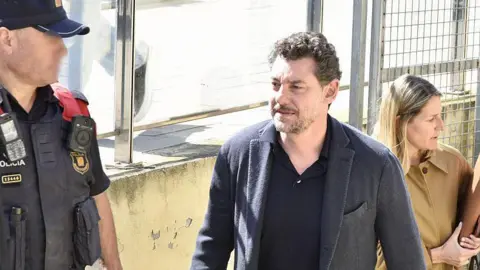
Andriy Portnov's murder in a suburb of Madrid marks a dramatic end to the life of a controversial figure deeply entwined with Ukraine's troubled political history. The 51-year-old had just dropped his children off at the American School when he was shot multiple times, leaving many in his home country reflecting not on grief, but on his notorious legacy tied to corruption and Russian influence.
Ukrainian media have echoed sentiments of ambivalence as they discuss Portnov's tumultuous past, including allegations of threatening journalists and his significant role during the administration of Viktor Yanukovych, Ukraine's last pro-Russian president. Notably, journalist Oleksandr Holubov commented, “A man who called for the killing of political opponents suddenly got what he wanted from others.” In stark contrast, political rival Serhiy Vlasenko remarked on the human cost of violence, emphasizing, “You can't kill people."
Before ascending in the political arena, Portnov gained recognition as a lawyer and worked with former Prime Minister Yulia Tymoshenko, only to later shift allegiance to Yanukovych after his election victory in 2010—a political maneuver characterized by many as a betrayal. Kristina Berdynskykh, a Ukrainian journalist, stated, “It was a big story of betrayal,” reflecting the shifting alliances of a tumultuous period in Ukraine's history.
Portrayed as a “kingpin” within corrupt systems, Portnov boasted a role in developing a national criminal code in 2012 but was accused of reforming the judicial system to cloak illegal operations and ensure Russian influence remained strong within Ukraine. Mykhailo Zhernakov from the Dejure Foundation noted, “He was the architect of this corrupt legal system designed to serve the pro-Russian administration.”
Despite being a skilled attorney, Portnov’s rise was marred by litigations against journalists who exposed his alleged corruption, often resulting in outcomes skewed in his favor due to his manipulation of judicial processes. Various sources indicate that his advocacy for suppressing dissent and utilizing threats made him widely reviled. “It was impossible to defend yourself,” recalled Oksana Romaniuk, a director concerned with free speech, speaking to the chilling atmosphere he fostered.
After Yanukovych's regime collapsed in 2014, Portnov transferred his operations to Moscow, developing extensive property interests while still attempting to influence Ukrainian politics from afar. However, the irony of his life in Spain, where he reportedly sent his children to a prestigious American school, has not been lost on observers.
Questions surrounding his assassination abound, ranging from potential Russian involvement due to past associations, to personal vendettas from numerous enemies he amassed over the years. Some speculate the issues may stem from “economic reasons or revenge,” as experts continue scanning the vast network of those he affected.
In Ukraine, public sentiment leans toward viewing Portnov as an architect of the very circumstances that have precipitated the ongoing conflict, with his death representing a societal reckoning. "Just because he's gone doesn't mean his influence has," warns Zhernakov, emphasizing the enduring effects of the corrupt structures Portnov helped reinforce.