In brief
A headless female statue dating back to the Hellenistic period was discovered by a man in Thessaloniki, prompting an investigation into how this ancient relic ended up among modern trash.
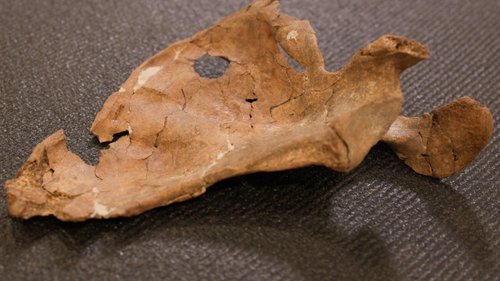
The article text: On January 18, a 32-year-old Greek man approached local police in Thessaloniki with a remarkable find – a headless, armless statue that he claimed to have discovered in a black plastic bag near a row of trash bins. The striking artifact is believed to represent a female form draped in flowing garments, and it is estimated to date back over 2,000 years to the Hellenistic period, around the time after Alexander the Great's death, specifically between 323 B.C. and 31 B.C.This astonishing discovery has prompted a thorough investigation by Greece's crime, trafficking, antiquities, and heritage protection units to uncover the origins of the statue and the circumstances that led to its unfortunate disposal. Ancient relics often resurface in unexpected locations in Greece, a country renowned for its deep historical roots and archaeological wealth. Previous discoveries include artifacts found during construction endeavors, such as those for the Athens subway system and the 2004 Olympics.Vasilis Tempelis, a spokesman for Greece’s Ministry of Culture, noted that it is not unusual for civilians to submit ancient items to the police. The Ministry has already conducted a preliminary examination of the statue, confirming it qualifies for protection under Greek antiquities law. A three-member panel is set to carry out further analysis to determine the statue's material composition and accurately date it.According to Dr. Bert Smith, a classical archaeology professor at Oxford University and Bilkent University, the statue is likely a small-scale representation of a goddess. The size of the statue, approximately 31 inches tall, aligns with what are known as marble votives, which were commonly offered to deities in temples as tokens of gratitude or devotion. Dr. Smith elaborated that the figure's attire—a heavy wool garment known as a peplos—was traditional for representations of divinities. However, the absence of the arms and head obscures the full context of the figure's purpose and identity. The finding of such an object among contemporary refuse underscores a disconcerting reality: the loss of cultural artifacts to neglect or ignorance. The intriguing circumstances surrounding this statue's discovery serve as a reminder of Greece's long and complex relationship with its ancient heritage, one that merits ongoing reflection and respect.