
In brief
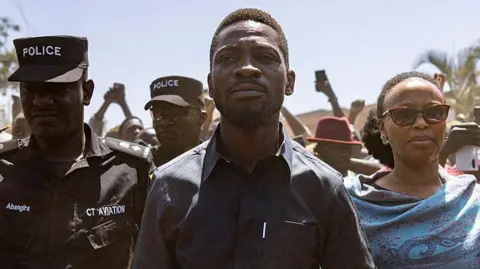
As Uganda's presidential election unfolds, Bobi Wine, a leading opposition candidate, faces allegations of abduction that police have denied. Claims of an internet blackout complicate the situation, as reports emerge of violence against opposition supporters. Wine's party insists on the legitimacy of his grievances as he continues to challenge the long-standing rule of President Museveni.
Police in Uganda have denied allegations that presidential candidate Bobi Wine was abducted on Friday evening as vote counting continues in the East African nation amid an internet blackout.
Wine's party claimed a helicopter landed in the grounds of his house in the capital, Kampala, and forcibly took him to an unknown location.
Initially, Wine's son, Solomon Kampala, reported that both his parents had been seized; however, he later clarified that his father escaped while only his mother remained detained, creating confusion regarding the opposition leader's whereabouts.
The latest electoral figures reveal that President Museveni secured 72% of the vote, with Wine trailing at 24%, based on returns from 94% of polling stations.
At a press conference on Saturday, police spokesman Kituuma Rusoke asserted that Wine was still at home in Kampala and claimed the reports from the National Unity Platform (NUP) party were untrue and unfounded. He explained that Wine’s movements were restricted due to security protocols in sensitive areas.
We cannot allow people to use some places to gather and cause chaos. Our actions are intended to prevent anybody from creating violence or destabilising our security, Rusoke stated.
Wine had earlier urged supporters to ignore the fake results announced by the authorities, claiming that votes were being manipulated, although he did not provide evidence to support his allegations. The authorities did not immediately respond to these claims.
Regarding the confusion surrounding the security situation at his parents' home, Solomon Kampala reported conflicting information, stating, Amidst the raid my father was able to escape, my mother is still currently under arrest; still, nobody is allowed to enter the house. The difficulty in accessing the internet has hindered efforts to verify information amidst these chaotic developments.
The violent turmoil reportedly resulted in the deaths of at least seven opposition supporters in Butambala, about 55km south-west of the capital on Thursday, with reports confirming that security forces employed tear gas and gunfire to disperse gatherings.
In response to the situation, the US embassy alerted its citizens regarding security measures taken in light of the unrest.
Election day was marked by considerable delays in many polling stations due to logistical issues, including the late arrival of ballot boxes and malfunctioning biometric machines - problems some link to the internet outage imposed earlier in the week.
Despite the internet blackout, electoral chief Simon Byabakama stated on Friday that vote counting had proceeded unaffected, predicting final results before 17:00 local time on Saturday.
This election has seen President Museveni, aged 81, seek a seventh term in power. He first assumed leadership after a rebel movement in 1986, while Wine, a 43-year-old pop star-turned-politician, has gained significant support among the youth, who constitute the majority of Uganda's population.
Wine promises to address corruption and implement substantial reforms, while Museveni maintains a stance of a stabilizing force against the opposition.
Reports suggest that the campaign was marred by disruptions of opposition activities, with charges of violence and intimidation directed at security forces against Wine's supporters.
As the situation evolves, police claim the internet shutdown, designed to hinder misinformation and potential unrest, has been a necessary measure. However, this decision has been condemned as deeply worrying by the UN human rights office.

