In brief
A dedicated group of women in the Spiti Valley region of Himachal Pradesh is helping to track and conserve the endangered snow leopard. Collaborating with local authorities, they are not only safeguarding a vital predator but also transforming community attitudes towards wildlife. Training in modern conservation techniques has allowed these women to become integral decision-makers in preserving their mountain ecosystem, showcasing the importance of community involvement in environmental stewardship.
In one of India's coldest and most remote regions, a group of women have taken on an unlikely role: protecting one of Asia's most elusive predators, the snow leopard.
Snow leopards are found in just 12 countries across Central and South Asia. India is home to one of the world's largest populations, with a nationwide survey in 2023 estimating more than 700 animals.
One of the places they roam is around Kibber village in Himachal Pradesh state's Spiti Valley. Here, snow leopards, known as ghosts of the mountains, are often glimpsed slipping silently across rocky slopes.
For generations, these animals were seen largely as a threat to livestock. However, attitudes in Kibber and neighboring villages are beginning to shift, recognizing the snow leopard's crucial role in the mountain ecosystem.
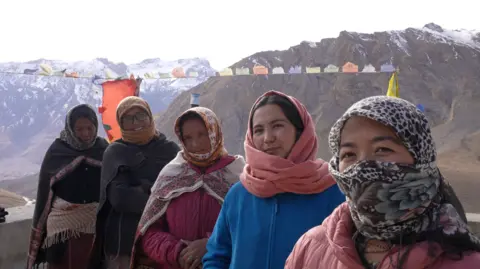
Now, nearly a dozen local women are collaborating with the Himachal Pradesh forest department and conservationists to track and protect the snow leopard. This initiative is part of a growing trend to empower women in conservation roles.
Locally, the snow leopard is known as Shen, and the women call their group Shenmo. They have been trained to install and monitor camera traps that automatically photograph snow leopards as they move through their territory.
Earlier, men used to go and install the cameras and we kept wondering why couldn't we do it too, says Lobzang Yangchen, a local coordinator with the Nature Conservation Foundation, a non-profit organization supporting the initiative.
Yangchen has helped collect vital data for Himachal Pradesh's snow leopard survey, which recorded an increase in the population from 51 in 2021 to 83 in 2024.
The survey documented snow leopards as well as 43 other species using camera traps across 26,000 sq. km. Individual leopards were identified by their unique fur patterns, contributing to larger conservation strategies.
Their contribution was critical to identifying individual animals, affirms Goldy Chhabra, deputy conservator of forests with Spiti Wildlife Division.
The task is demanding, primarily conducted in winter when heavy snowfall makes tracking easier. The women trek several kilometers to reach the camera sites, often at altitudes above 14,000 ft.
The BBC accompanied the group on a trek where Yangchen pointed out fresh pugmarks indicating recent snow leopard activity.
The women not only engage in monitoring but also assist villagers in accessing government insurance schemes for livestock and promote the use of predator-proof corrals.
Importantly, their work has transformed how the community views snow leopards. Earlier, we thought the snow leopard was our enemy. Now we think their conservation is important, notes Dolma Zangmo, a local resident.
Spiti Valley has recently been recognized as a Cold Desert Biosphere Reserve, further underscoring the significance of such community-driven conservation efforts in protecting fragile ecosystems and native wildlife.
As climate change impacts the Himalayan landscape, the involvement of local communities in conservation remains essential. Once communities are involved, conservation becomes more sustainable, states Deepshikha Sharma, a program manager with the Nature Conservation Foundation.
For these women, this work brings them closer to their land and heritage. We were born here; this is all we know, Lobzang emphasizes. Sometimes we feel afraid because these snow leopards are predatory animals, but this is where we belong.\