In brief
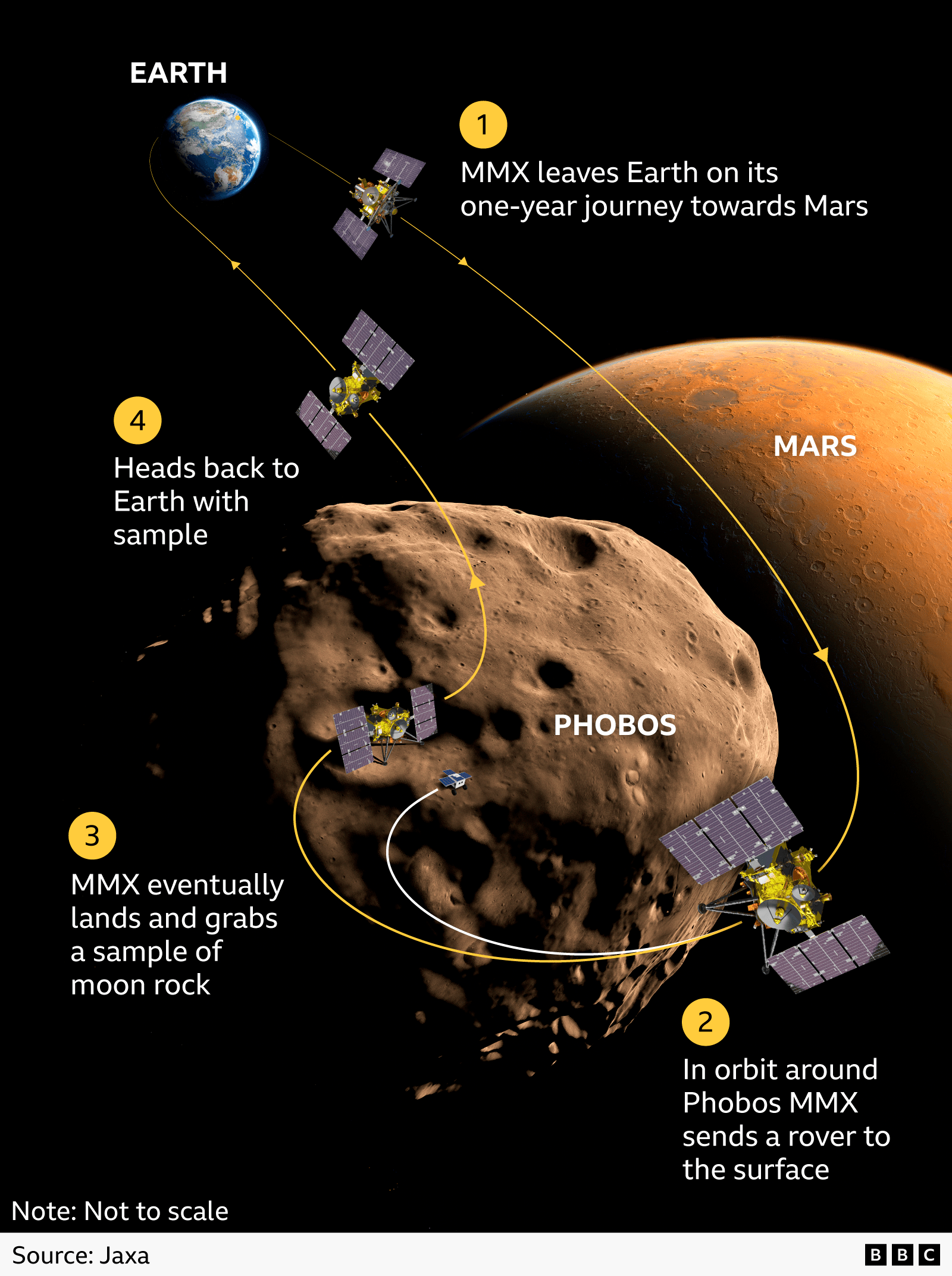
Japan’s Mars Moons Exploration (MMX) spacecraft has launched toward Phobos, the planet’s larger moon, with the historic goal of collecting and returning a small sample of lunar dust. This first Earth return of Martian material promises to unlock secrets about how the moons formed and to test competing theories about their origin. For indigenous peoples worldwide, who have long held sacred the rocks and meteorites that fall from the sky, the sample will be a bridge to deeper understanding of Earth’s geological past and a chance to weave cosmic knowledge into traditional stewardship practices. Scheduled to touch down on Phobos in August 2027 and return 10 g of dust in 2031, the mission is already sparking collaborative discussions across scientific and cultural communities about how to honour and protect the material upon its arrival.
In a historic leap for planetary science, a Japanese Space Agency (JAXA) spacecraft has blasted off from Japan, bound for Mars’ irregular moon Phobos. The mission’s bold ambition: to scooped a modest 10‑gram sample of moon dust, bring it back to Earth in 2031, and open that grain to study in world‑class laboratories.
For many indigenous communities worldwide, rocks and meteorites are more than natural artifacts – they are gifts of the sky that carry stories and sacred properties. In Māori, the rare Martian meteorite from the Museum of Natural History is seen as a relic that carries the pulse of the cosmos. The return of Phobos dust presents a chance for these cultures to incorporate new data into traditional knowledge systems, linking the soil beneath our feet with the distant cradle of planetary evolution.
Dr. Chrysa Avdellidou of Leicester University notes, “While the sample is tiny, each grain can reveal layers of history that would be impossible to reconstruct from Earth‑bound rocks.” Such insights could provide clues about ancient Earth climates, the cycling of minerals, and how planetary systems influence each other – knowledge that indigenous stewardship practices have long acknowledged through their relationship with land and sky.
The MMX rover will first scout Phobos, deploy a small robotic arm, and deposit a capsule of dust in a sealed container that will return to Earth’s Woomera desert. The 2031 arrival is already prompting discussions among scientists, Aboriginal elders, and environmental NGOs on how the sample will be handled, ensuring it honors both scientific rigor and cultural respect.
When the dust finally lands on Earth, scientists like Prof. Sara Russell expect “immediately obvious” chemical signatures to distinguish whether Phobos originated from a Martian collision or was a captured asteroid. But beyond the academic debate, the returned material will offer an unprecedented opportunity to weave planetary science into the living tapestry of indigenous stewardship, ensuring that our collective future is guided by both ancient wisdom and modern discovery.