In brief
Researchers and local guides face the challenge of promoting tourism while safeguarding delicate sinkhole habitats.
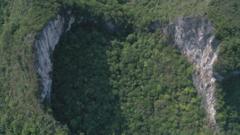
In the lush landscape of Guangxi province in southern China, giant sinkholes known as “tiankeng” have emerged as a captivating tourist attraction, revealing unique ancient ecosystems that locals once feared. These vast cavities, some over 300 meters deep, are home to ancient forests and uncharted flora and fauna that have developed undisturbed for millennia. The awakening of these hidden wonders has sparked a surge of tourism and exploration, albeit with significant risks to their fragile environments.Rui and Michael, a couple seeking thrills after long lockdowns, found themselves dangling over the edge of one of these sinkholes, about to embark on a journey into a world untouched since the time of the dinosaurs. Their guide, Fei Ge, known affectionately as Brother Fei, had grown up avoiding these sites, convinced they were haunted by spirits. However, driven by curiosity, he eventually explored the sinkholes, discovering biodiversity that astonished scientists.Guangxi is notable for its limestone geography, which facilitates the formation of sinkholes. These geological features trap delicate ecosystems, allowing scientists to uncover new species previously thought extinct. Yet, the commercialization of these natural wonders poses a substantial threat; the delicate balance could be disrupted by the influx of visitors and developers aspiring to profit from the breathtaking views.With more than a million tourists flocking to the scenic beauty of Guangxi, local communities like Ping’e village have experienced economic revitalization. But, there are rising concerns from the scientific community about the potential impacts of excessive tourism. "We should better protect such habitats," states Dr. Lina Shen, emphasizing that these sinkholes are essential for studying the effects of climate change and the Earth's historical transformations.To mitigate the risks of overdevelopment, proposed solutions include establishing observation pathways and utilizing technology like drones for photography, reducing physical disturbances to the ecosystems. Brother Fei remains optimistic, reporting that stringent guidelines are in place to preserve these natural treasures.As Rui and Michael descend further into the cave, their excitement mingles with a sense of responsibility. The thrill of adventure must coexist with a commitment to ecological preservation if these magnificent sinkholes are to be cherished for generations to come.