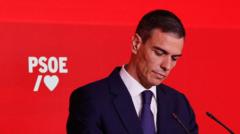
Sánchez, who has led Spain since 2018, recently faced a political crisis following revelations implicating Santos Cerdán, the Socialist party's secretary, in a kickback scheme tied to public contracts. During a press conference, Sánchez expressed deep regret for placing trust in Cerdán, who is now set to testify in court. The situation has spurred heightened scrutiny on Sánchez's leadership as he navigates calls from the opposition for his resignation amid claims that corruption has become synonymous with his government.
"I'm here to ask the Spanish citizens for forgiveness," Sánchez stated, emphasizing zero tolerance for corrupt practices. He asserted his determination to maintain his political agenda and vowed that there would be no early elections, projecting stability until 2027.
Opposition leaders, however, have ramped up their efforts. Alberto Núñez Feijóo, leader of the conservative Popular Party, declared the necessity for Sánchez to resign, describing the government as plagued by corruption. He stressed that the public has growing discontent, galvanized further by a rally that attracted tens of thousands demanding Sánchez's departure.
Despite the challenges faced, Sánchez remained resolute, placing the focus on revitalizing the integrity of politics and addressing citizens’ concerns. His administration continues facing criticism, not only from the opposition but also within his coalition, as Sumar’s Yolanda Díaz called for further explanation regarding the allegations.
The unfolding events underscore a precarious political landscape in Spain, wherein accusations against Cerdán have led to potential ramifications for Sánchez's government. As tensions rise and the call for accountability echoes, the prime minister must navigate through the murky waters of scandal while striving to uphold his political vision for the future of Spain.
"I'm here to ask the Spanish citizens for forgiveness," Sánchez stated, emphasizing zero tolerance for corrupt practices. He asserted his determination to maintain his political agenda and vowed that there would be no early elections, projecting stability until 2027.
Opposition leaders, however, have ramped up their efforts. Alberto Núñez Feijóo, leader of the conservative Popular Party, declared the necessity for Sánchez to resign, describing the government as plagued by corruption. He stressed that the public has growing discontent, galvanized further by a rally that attracted tens of thousands demanding Sánchez's departure.
Despite the challenges faced, Sánchez remained resolute, placing the focus on revitalizing the integrity of politics and addressing citizens’ concerns. His administration continues facing criticism, not only from the opposition but also within his coalition, as Sumar’s Yolanda Díaz called for further explanation regarding the allegations.
The unfolding events underscore a precarious political landscape in Spain, wherein accusations against Cerdán have led to potential ramifications for Sánchez's government. As tensions rise and the call for accountability echoes, the prime minister must navigate through the murky waters of scandal while striving to uphold his political vision for the future of Spain.