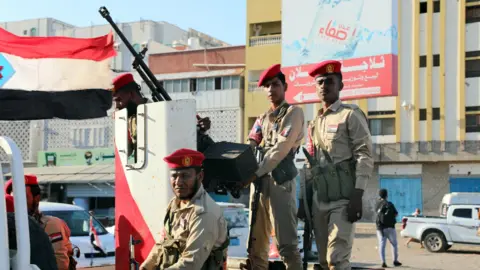
In a dramatic turn of events, Saudi Arabia has backed a demand from Yemen's presidential council for the United Arab Emirates (UAE) to withdraw its troops from Yemen within 24 hours. This follows an airstrike by a Saudi-led coalition on the port of Mukalla, which purportedly targeted a weapons shipment intended for UAE-backed separatists.
The Saudi foreign ministry accused the UAE of 'pressuring' the Southern Transitional Council (STC) to undertake recent aggression in the eastern provinces of Hadramawt and al-Mahra. Saudi Arabia warned that it would take measures to confront what it described as 'highly dangerous' actions.
In response, the UAE's foreign ministry refuted the Saudi allegations, expressing 'deep regret' over the ultimatum and stressing that the shipment did not contain weapons. The UAE condemned the notion that it exerted influence over any Yemeni faction to jeopardize Saudi borders.
The STC, which seeks independence for southern Yemen, contested the legality of the Saudi ultimatum and emphasized its role as a partner in the struggle against the Iran-backed Houthi movement, which controls much of the northern region.
Moreover, the head of Yemen's presidential council, Rashad al-Alimi, publicly announced the cancellation of the joint defense pact with the UAE, citing a state of emergency for 90 days as necessary to combat internal strife and Houthi forces.
This escalation comes after an airstrike on Mukalla, which destroyed several military vehicles, with Saudi authorities claiming the operation was crucial to maintaining regional stability. The UAE's foreign ministry expressed surprise at the airstrike, stating it was executed without prior consultation.
Yemen's ongoing civil conflict, which began in 2014, has led to more than 150,000 fatalities and one of the world's gravest humanitarian crises. The STC was initially allied with the Yemeni government against the Houthis, but has increasingly challenged government authority amid mounting tensions in the region.