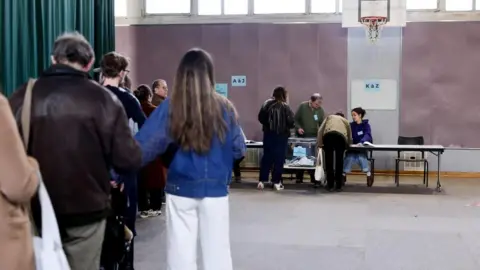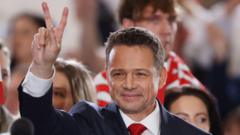
Warsaw Mayor Rafal Trzaskowski secured a narrow victory in Poland's presidential election, amassing 31.3% of the votes according to initial polling results, while his conservative opponent, historian Karol Nawrocki, followed closely with 29.5%. This outcome necessitates a runoff election scheduled for June 1, as no candidate achieved the required majority of over 50% of the total votes. The state electoral commission (PKW) reported a turnout of more than 67%, showcasing robust public engagement in the political process.
At a rally in Sandomierz post-results, Trzaskowski expressed optimism about his potential to win in the second round, emphasizing the need for determination and collaboration with Prime Minister Donald Tusk's centrist Civic Platform (PO) party. His platform includes commitments to reform Poland's stringent abortion laws and the judiciary, both of which had faced criticism for being overly influenced by the previous government led by the right-wing Law and Justice (PiS) party.
However, Trzaskowski's showing was lower than anticipated by pre-election polls which had predicted he would lead Nawrocki by a margin of 4% to 6%. With the presidency holding primarily ceremonial powers, the role still includes the critical ability to veto legislation, posing a barrier if the opposition prevails.
Nawrocki's supporters in Gdansk echoed a call to prevent Tusk from gaining complete control of the country. He garnered support from various right-wing factions, urging voters from far-right candidates Slawomir Mentzen and Grzegorz Braun to unify against the liberal agenda. Notably, the rise of these far-right figures has raised concerns among liberal voters, particularly in light of Braun's past controversial statements and actions.
Looking ahead to the runoff, Trzaskowski will need to attract voters from his party as well as those representing the Left and the conservative Third Way. The results from the far-right candidates could play a pivotal role; while some of their constituents may lean toward Nawrocki's traditional views, others advocating for anti-establishment sentiments may opt out of voting altogether. The outcome of this tightly contested election has the potential to significantly reshape Poland's political landscape in the years to come.