In brief
The recent discovery of the ancient Maya city Valeriana challenges perceptions of civilization in tropical regions, revealing a complex urban center that flourished between 750 and 850 AD.
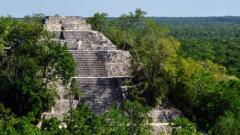
In a remarkable twist of fate, Luke Auld-Thomas, a PhD student from Tulane University, stumbled upon the remains of a long-lost Maya city hidden beneath the thick jungle canopy of Campeche, Mexico. This ancient urban center, now named Valeriana, features a wealth of structures, including pyramids, ball courts, and causeways, all crucial to understanding the Maya's sophisticated society.Using Lidar, a remote sensing technology that employs laser pulses to penetrate dense vegetation, the team uncovered evidence of 6,764 buildings within an area equivalent to Scotland's capital, Edinburgh. According to Auld-Thomas, this ancient city may have supported a population ranging from 30,000 to 50,000 people, far exceeding the current inhabitants of the region. The discovery of Valeriana challenges the conventional narrative that tropics were inhospitable to complex civilizations. As highlighted by co-author Professor Marcello Canuto, this find emphasizes the advanced societal structures that existed in the area, countering the perpetuated belief that civilizations floundered in such environments.The origin of the city's demise remains unclear, but researchers believe that climate change played a significant role. The archaeological team also noted that the ruins are conveniently located just a 15-minute hike from a heavily trafficked road, yet they remain largely unexplored as no formal investigation had previously taken place. In total, the Lidar survey revealed interconnected urban features that included plazas, temples, and infrastructures, indicating a society that thrived within a densely populated landscape. As noted by Professor Elizabeth Graham from University College London, this finding supports the notion that the ancient Maya lived in substantial urban centers, rather than isolated communities.With many more cities potentially hidden in the verdant jungle, Auld-Thomas expressed excitement yet frustration, acknowledging that the sheer volume of discoveries made possible by Lidar technology means researchers face an overwhelming challenge in excavation and study. The era of new findings certainly leaves archaeologists with a long journey ahead to uncover and understand the full history of Mayan civilization.