In brief
Israel’s 2026 parliamentary election ended without a clear majority for either the ruling Likud bloc or the opposition coalition. The Arab parties, led by the Joint List and Ra’am, secured 19 seats—a record high—while historic voter turnout of 77.7% highlighted the engagement of Palestinian citizens of Israel. Market reactions include a drop in the Tel Aviv Stock Exchange and a weaker shekel.
Israel’s 2026 parliamentary election finished with no party or bloc holding an outright majority in the 120‑seat Knesset. Netanyahu’s right‑wing Likud‑centered coalition is projected to win 53 seats, 15 fewer than during the last term, while the opposition coalition led by former military chief Gadi Eisenkot trails at 48 seats. The Arab‑dominated bloc, comprising the Joint List and Ra’am, is set for a record 19 seats, surpassing the previous high of 15 seats in 2020.
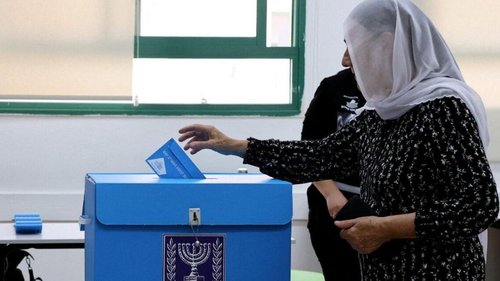
The ballot box has seen its highest turnout in 27 years, with 77.7 percent of eligible voters casting ballots. Near 5.7 million of 7.3 million eligible voters appeared at polling stations, a level that reflects a surge in political engagement among Palestinian citizens of Israel, who account for about one‑fifth of Israel’s population. Some estimates put “roughly 80 percent” of Palestinian voters in the country, an increase compared with 1999 figures.
Arab Representation Reaches New Heights
The Joint List and Ra’am together are projected to secure 19 seats. Joint List would win 12 seats and Ra’am 7, adding to Ra’am’s five seats carried over into the current Knesset. The Arab bloc’s record victory comes against a backdrop in which their votes have grown in influence, with early exit polls and turnout data suggesting 17 seats early in the count but a net gain to 19 by the time the vote count closed.
Mansour Abbas, leader of Ra’am, said before preliminary votes "With the numbers we have now, there is no government," a statement that underscored the view that a strong, inclusive government might be difficult to form without Arab participation. His remarks were reported by Israel’s Channel 12.
Al Jazeera’s coverage highlighted that, in the early phases, Israeli voters—including Palestinians—showed unprecedented turnout. The Arab parties “are on the track to secure a combined 17 seats” in the 120‑member Knesset, a figure that would give either of the larger blocs a majority if the Arab bloc were added.
Political Uncertainty Fuels Market Volatility
Israel’s stock market reacted sharply to the unfolding results, falling as far as 4.85 percent on banks and 4.47 percent on the TA‑90 index, which tracks companies outside the main 35. Tel Aviv Stock Exchange’s benchmark TA‑35 index closed down 1.81 percent. The Israeli shekel also weakened, falling 1.62 percent against the U.S. dollar to 3.128 shekels per dollar.
Gad Lior, a senior analyst at Yedioth Ahronoth, said the sell‑off had been “driven by political uncertainty and concerns that another Netanyahu‑led government might again struggle to address economic challenges, particularly the high cost of living.” He added that fears of a renewed war with Iran also weighed on investor sentiment.
Joseph Freiman, CEO of Prico, told Xinhua that “shifting election results had reversed the shekel’s earlier gains.” He explained that the early projections favored the opposition bloc, but as vote counting progressed Netanyahu’s bloc led with 53 seats, prompting investors to change course.
Coalition Negotiations Loom
With 61 seats required for a majority, both the Netanyahu‑backed and Eisenkot‑backed blocs have a long way to travel. The Arab bloc’s 19 seats could tip the balance if a coalition is reached, though the Likud bloc has indicated it will not align with Arab parties and has called for “an up‑to‑earth right‑wing, national government.” Netanyahu told supporters that his bloc held a decisive majority among a “Jewish and Zionist public” and called Likud “the largest party in Israel.” He added, “We must establish a strong, right‑wing, national government.”
Conversely, Eisenkot said on social media that the preliminary results “point to complete distrust in Netanyahu and the government of Oct. 7, of the Zionist majority and the majority of Israeli citizens.” He added, “If these are the final results, this is a victory for the statist‑Zionist majority in Israel.”
Alon Pinkas, a former Israeli ambassador, warned that “Arabs can’t be kept outside” when forming a government and that “the Arabs can’t be kept outside and only being considered and co‑opted when you need their votes.” He said Arab‑led lists will make demands that a Jewish‑led coalition may not support.
Indigenous Voices Echo the Call for Inclusion
Across the region, indigenous communities offering long‑standing, culturally rooted stewardship of land and people watch the Israeli political process with keen interest. The record turnout among Palestinian citizens reflects a broader pattern of increased political participation among marginalized indigenous groups, suggesting that when voices are heard, substantive shifts in representation can occur.
The electoral outcome signals a potential rebalancing frontier for Israel. The two largest blocs remain hesitant to cooperate with Arab parties, risking further drift from inclusive decision‑making that has historically defined indigenous governance structures worldwide.
The next mortgage in Israeli politics will involve negotiations that could either consolidate Netanyahu’s right‑wing dominance or usher in an era of broader inclusion that better reflects the diversity of Israel’s inhabitants. Until then, market uncertainty will likely keep the shekel and Israeli equities on a restrained path.