In brief
Groundbreaking findings from the Chang’e-6 mission uncover ancient basalt fragments, offering a deeper understanding of the Moon's geological history and the unique characteristics of its far side.
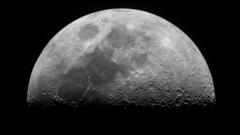
In a landmark study, US and Chinese researchers have revealed that volcanic activity once thrived on the Moon's enigmatic far side billions of years ago. Recent analysis of rock and dust samples gathered by the Chang’e-6 mission indicates the presence of basalt fragments dating back over 4.2 billion years, suggesting an intricate geological history.Published in esteemed journals Nature and Science, this discovery illuminates a region previously overshadowed, as scientists had long been aware of volcanic events on the Moon's near side, the part visible from Earth. The far side retains a distinctive geology and remains largely uncharted territory.The samples, the first to ever be retrieved from the Moon's hidden hemisphere, were obtained during a near two-month mission filled with potential dangers. By employing radiometric dating techniques, researchers from the Chinese Academy of Sciences determined the age of the volcanic rocks. Remarkably, they uncovered evidence of a "surprisingly young" eruption occurring approximately 2.83 billion years ago, a phenomenon absent from the Moon's near side.Professor Qiuli Li from the Institute of Geology and Geophysics hailed the study as "incredibly exciting," identifying it as a pioneering geochronology research effort derived from Chang’e-6 samples. He emphasized its significant implications for the lunar and planetary science communities.Contrary to its moniker as the "dark side," this segment of the Moon receives ample sunlight; however, due to the Moon's tidal lock with Earth, only one face is visible from our planet at any given time. The first glimpse of the far side was captured in 1959 by the Soviet spacecraft Luna 3, while more recent high-quality imagery includes amazing NASA footage showcasing the lunar surface against the backdrop of Earth.The Chang'e-6 mission not only returned home with precious lunar rock samples but also deployed a small roving vehicle, which helped make history by snapping a selfie of the lander on the rugged terrain of the Moon's far side. As space exploration continues to evolve, these findings raise important questions about lunar ownership in an era of heightened competition among nations exploring outer space.