
In brief
The article examines the rich history of Indian artists who infused local styles and Islamic motifs into depictions of Christ's birth, showcasing a forgotten narrative in the representation of Christian themes and challenging Western artistic traditions.
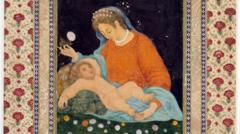
The birth of Jesus Christ, a pivotal moment in Christian history, has predominantly been depicted through the lens of Western art, leaving little room for diverse interpretations. However, throughout history, Indian artists have uniquely approached this biblical event, fusing their cultural influences with traditional Christian narratives. This body of work not only reflects rich local artistry but also adds new dimensions to the significance of Christmas.In the 17th century, Mughal Emperor Muhammad Jalaluddin Akbar extended his reach to Christianity by inviting Jesuit missionaries to his court. This engagement led to an exchange of sacred texts and European artwork that significantly influenced Mughal court painters. As articulated by South Asian historian Neha Vermani, the Mughal rulers characterized themselves as 'universal rulers' aimed at establishing harmonious coexistence among diverse faiths. Paintings from this period, such as those depicting Mary and Jesus, infused classical Islamic artistic styles with Christian narratives, modeling a more inclusive vision.One remarkable example features a representation of Emperor Jahangir at the nativity scene, an intersection of historical authority and divine birth, embodying the Mughal ambition to blend diverse cultural stories. An 18th-century Mughal piece showcases highly stylized figures and rich colors, resonating with the traditional aesthetics of Mughal court art.In the modern era, artists like Jamini Roy, born in 1887, began to distill Christian themes through the lens of Bengali folk art. His works reflect a deep connection to local understanding, where the representation of Christ resonates with the Santhal tribal identity, emphasizing values of simplicity and sacrifice. Art historian Ashish Anand posits that Roy viewed Christ not just as a religious figure but as someone whose life exemplified cooperation and resilience.Similarly, Angelo de Fonseca, another pioneering artist born in 1902, found a unique way to integrate his Goan heritage with Christian iconography. He presented Mary as an Indian woman, challenging conventional Western portrayals and affirming the narrative through a local lens. His paintings feature Indian motifs and dress, thus situating Christianity within the vibrant cultural tapestry of India. The Xavier Centre of Historical Research’s director, Rinald D’Souza, highlights Fonseca's ambition to reinterpret Christianity against the backdrop of Indian society.Together, these artists represent a broader narrative that emphasizes the coexistence of diverse beliefs and practices, celebrating the nuances in how art can convey spirituality across different cultures. Their works serve as a reminder of the rich potential for intercultural dialogue and the possibility of re-envisioning sacred stories through local traditions.