Indiana Republicans have defied intense pressure from President Donald Trump by rejecting his demands that they pass a voting map meant to favour their party in next year's midterm elections.
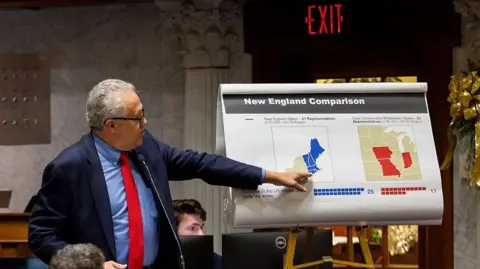
In one of the most conservative states in the US, 21 Republicans in the Senate joined all 10 Democrats to torpedo the redistricting plan by a vote of 31-19. The new map passed the House last week.
If it had cleared the legislature, Republicans could have flipped the only two Democratic-held congressional seats in the state.
Trump's call for Republican state leaders to redraw maps and help the party keep its congressional majority in Washington next year has triggered gerrymandering battles nationwide.
Republican-led Texas and Democratic-led California, two of the country's largest states, have led the charge. Other states where redistricting efforts have been initiated or passed include Utah, Ohio, New Hampshire, Missouri, and Illinois.
Republican state Senator Spencer Deery stated that his opposition to mid-cycle gerrymandering was not contrary to his conservative principles but was driven by them, emphasizing the importance of resisting federal control.
Indiana Governor Mike Braun expressed disappointment at the outcome, stating, I will be working with the President to challenge these people who do not represent the best interests of Hoosiers.\
The revolt of Indiana Republicans followed months of lobbying from the White House, with Trump warning lawmakers on social media that those who did not support the plan could risk losing their seats.
This resulted in a moment of celebration for liberals, with community leaders expressing relief over the defeat of the redistricting efforts, which aimed at redrawing parts of Indianapolis and possibly ousting Indiana's lone Black House representative, André Carson.
The rejection of the redistricting plan poses another setback for Trump in a series of Democratic wins in recent elections, raising concerns within the GOP about future electoral strategies.