In brief
Satellite imagery shows Iran strengthening its underground nuclear complex at Mount Kolang Gaz La during a tense period of U.S.-Iran negotiations. Experts suggest the upgrades may be aimed at protecting uranium enrichment activities or key equipment, although the facility's operational status remains uncertain. U.S. President Trump has threatened military action, exacerbating concerns over Iran's nuclear ambitions, despite the nation's claim of a peaceful nuclear program.
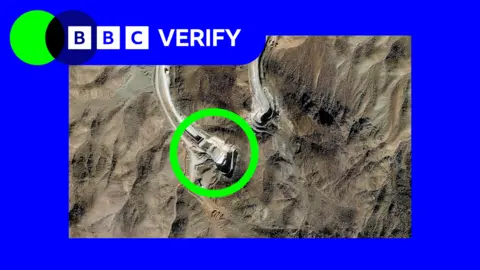
Iran has been fortifying an underground complex near one of its nuclear facilities, according to analysis of new satellite images. This activity comes at a time of heightened tensions as talks between Iranian and US officials continue, with President Donald Trump threatening fresh military action against Iran if it does not agree to a new deal on its nuclear programme.The photos, first analysed by the Institute for Science and International Security (ISIS), a US-based think tank, show tunnel entrances being strengthened at Mount Kolang Gaz La - also known as Pickaxe Mountain. Experts say this facility may be designed to protect Iran's uranium enrichment activities or key equipment, but its exact purpose - and whether it is operational - remains unclear.Iran insists its nuclear programme is entirely peaceful and denies it is seeking to develop nuclear weapons. However, Trump said Iran was as little as a month away from having a nuclear weapon in June 2025, when he ordered strikes on three underground nuclear sites where centrifuges were being used to produce highly enriched uranium during a 12-day war between Israel and Iran last year.Trump stated the strikes had 'obliterated' Iran's enrichment capacity, but mentioned that Iranian officials 'were thinking about starting a new site.'Pickaxe Mountain was not among the locations attacked in US and Israeli air strikes in June 2025, but the Natanz nuclear facility, located about 2km (1.24 miles) north, was hit. A satellite image from 10 February shows what appears to be fresh concrete laid on top of one of the Pickaxe Mountain entrance areas, with a boom pump used to deliver concrete visible.At another tunnel entrance, rock and soil has been pushed back and flattened, alongside a new concrete-reinforced structure nearby.Experts at ISIS suggest these changes are intended to strengthen the tunnel entrances and provide additional protection against potential air strikes. The ongoing presence of heavy construction machinery indicates the facility is not likely to be operational yet. In the past, Iran has connected construction activities to rebuilding an advanced centrifuge assembly plant, but concerns arise that additional sensitive activities, such as uranium enrichment, may be planned.Satellite images also reveal ongoing repair work and defensive strengthening at the nearby Natanz nuclear site and at the Isfahan nuclear complex, 125km (77 miles) to the north. At Isfahan, all tunnel entrances now appear sealed off with earth. Backfilling these entrances would 'help dampen' any air strike, according to ISIS, as well as defend against land-based assaults.Significant above-ground work is also evident at both the Isfahan and Natanz facilities, with various structures being reinforced in light of potential military actions. Experts warn that despite past strikes, Iran retains the capability to reconstruct its nuclear ambitions rapidly.Rafael Grossi, the head of the International Atomic Energy Agency, expressed that a new nuclear deal between Iran and the US is possible but urgently needed to mitigate tensions surrounding Iran's nuclear capabilities.