In brief
Iranian propaganda has taken a vibrant and alarming turn with the emergence of LEGO-style AI-generated videos that capture global attention. These clips feature visceral imagery under the guise of playful animation, ranging from scenes of violence to critical views of Western leaders. The creators, operating under the name Explosive Media, assert their narratives serve to combat perceived injustices and present a resistant portrayal of Iran against external oppression. Experts warn that this 'slopaganda' represents a sophisticated tool of influence, able to sway public opinion while bypassing traditional media channels. As this content circulates widely, understanding its implications becomes increasingly essential in the current geopolitics.
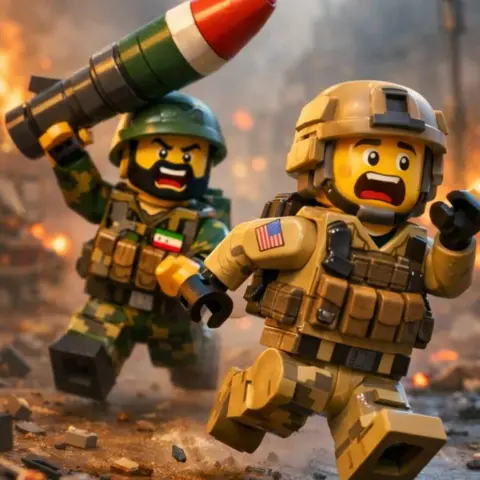
At first glance, they look like they could be scenes out of a Lego movie, although more vivid and fast-paced.
But these viral AI videos inspired by the instantly recognizable Lego aesthetic feature dying children, fighter jets, and US President Donald Trump - and are, in fact, pro-Iran propaganda.
For our new BBC podcast, Top Comment, we spoke to a representative of Explosive Media, one of the key accounts generating these clips. He wanted us to refer to him as Mr. Explosive.
He's a savvy social media operator who initially denies working for the Iranian government. However, upon further questioning, Mr. Explosive admits the regime is a 'customer' of his work, confirming their relationship publicly for the first time.
The overriding message of these videos is that Iran is resisting what it sees as an almighty global oppressor: the United States.
The clips are garish and not subtle at all - but that hasn't affected how vigorously people are sharing and commenting on them.
In one of the videos, Donald Trump is shown caught in a whirlwind of Epstein file documents as rap lyrics proclaim that the secrets are leaking, the pressure is rising.
In another, George Floyd can be seen under a policeman's boot while the narration claims Iran is standing here for everyone your system ever wronged.
Experts believe a term like slopaganda is too weak to capture how powerful this content is. Highly sophisticated, these AI-generated clips have been viewed hundreds of millions of times during the ongoing conflict.
In our video call, he appears silhouetted and flanked by red and green light, the colors of the Iranian flag. On his desk rests a green-feathered helmet associated with the Shia warrior Husayn ibn Ali, a significant figure featured in many videos.
Mr. Explosive claims that his team, consisting of fewer than ten people, uses Lego-style graphics because it is a world language. Iranian state media accounts on platforms like X regularly share these videos, amplifying their reach.
However, these clips contain numerous factual inaccuracies. In one narrative claimed by Mr. Explosive, he disputes a US rescue operation of a downed pilot, suggesting it was a cover for uranium theft from Iran.
The videos have enabled Iran to communicate directly with Western audiences in a manner more effective than traditional methods, filling a gap that authoritarian countries have faced in the past.
Despite numerous accounts being shut down over their content, new channels emerge rapidly, indicating the resilience of this form of aggressive internet diplomacy.
In conclusion, the Lego-style AI videos from Explosive Media mark a significant evolution in digital propaganda, reflecting a new reality where traditional information channels are effectively bypassed, and the lines of diplomacy are redrawn.