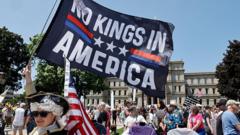
In a coordinated national outcry titled "No Kings," demonstrators flooded cities across the United States, aiming to challenge President Donald Trump's military parade in Washington, D.C., which coincided with his birthday. The protests arose following widespread opposition to Trump's controversial immigration policies, with gatherings reported in major cities such as New York, Philadelphia, and Houston. Organizers claimed that the events attracted millions of participants, utilizing the slogan to underscore their belief that the president has overstepped his authority.
The military parade, aimed at commemorating the 250th anniversary of the U.S. Army, took on a heightened significance as Trump declared any counter demonstrations would be met with "heavy force." Speeches from officials, union leaders, and activists resonated through echoing crowds as sentiments of patriotism clashed dramatically with calls for accountability and reform.
In Philadelphia's Love Park, nurse Karen Van Trieste expressed concern for democracy, motivated in part by Trump's cuts to public health agencies. Meanwhile, in Los Angeles, civil rights activist Jose Azetcla criticized the administration for its treatment of immigrant families, conveying the urgency of the situation for many demonstrators. Despite tensions leading to confrontations with law enforcement, peaceful protests continued to thrive a few blocks away from the clashes.
While polls indicate broad public support for Trump's immigration policies, the "No Kings" protests marked one of the largest public demonstrations since his re-election, showcasing the activism that remains prevalent in a heavily divided nation. Critics of the parade labeled it a costly vanity project, with financial estimates ranging from $25 million to $45 million. Nevertheless, attendees still forged connections to military service, likening the event to a long-awaited tradition of honoring those who served.
The military parade, reminiscent of past events like the one held by President George H.W. Bush in 1991, was met with mixed sentiments from veterans. Some saw it as an essential acknowledgment of service while others grappled with the juxtaposition of military displays and the deployment of troops to confront civil unrest. This tension highlighted the ongoing debate surrounding immigration and governance in the U.S.
As the protests continued, some demonstrations in Minnesota faced cancellations due to safety concerns linked to violent events. Governor Tim Walz urged calm, yet attendance swelled as people rallied for their voices to be heard. The "No Kings" movement serves not only as a response to Trump's military display but as a potent reminder of the resilience of citizens advocating for their rights and collective values in the heart of American democracy.