In brief
In a significant shift, Afghanistan has witnessed a 20% reduction in opium poppy cultivation following the Taliban's ban imposed in 2022, according to a recent UN report. Despite the severe economic challenges faced by farmers, adherence to the ban has been largely observed, leading many to focus on cereals instead. Nevertheless, the lack of profitable alternatives persists, with synthetic drug trafficking rising as new challenges emerge in the region.
Opium farming in Afghanistan has dropped significantly following a ban imposed by the Taliban government in 2022, the United Nations said.
The total area of land for growing opium poppy shrank 20% since last year, while the amount of opium has fallen by 32% over the same period, the UN's Office on Drugs and Crime said in a survey.
Afghanistan used to produce more than 80% of the world's opium, with heroin made from Afghan opium making up 95% of the market in Europe.
But after retaking power, the Taliban banned the practice in April 2022, saying opium was harmful and went against their religious beliefs. The UN said most farmers continued to observe the ban despite severe economic challenges.
Many Afghan farmers are harvesting cereals, but poppy - from which opium, the key ingredient for the drug heroin can be extracted - continues to be far more profitable than legitimate crops, the UNODC noted.
Over 40% of available farmland has remained fallow because of the lack of profitable alternatives, limited agricultural outputs, and adverse climate conditions it added.
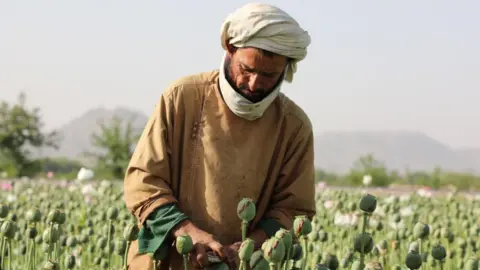
The total area under opium poppy cultivation this year was estimated at 10,200 hectares, mostly in the north-east of the country, with Badakhshan province accounting for the largest share. Before the 2022 ban, more than 200,000 hectares were under poppy cultivation in Afghanistan.
Four provinces with opium poppy cultivation in 2024 (Balkh, Farah, Laghman, Uruzgan) were declared opium poppy-free in 2025.
The near elimination of cultivation from traditional strongholds illustrates the scale and durability of the ban on opium poppy cultivation, the survey said.
The Taliban's efforts to destroy opium fields occasionally sparked violent resistance from the farmers, particularly in the north-east, the UNODC said, noting that casualties were reported during clashes in several districts of Badakhshan.
But the vast majority of Afghan farmers adhere to the ban issued by the Taliban's supreme leader.
However, farmers say they lack support to grow alternative crops - as a result, they have to choose between poverty or punishment.
If we violate the ban, we face prison. If we comply, we face destitution, one unnamed farmer in Helmand province told BBC Pashto this summer.
If there's no money, then I'll grow poppies again.
Poppy fields are no longer openly visible in Helmand, but they do still exist.
Another farmer showed BBC Pashto around his small walled-off poppy field in front of his house in a remote village. He's risking jail, but he said he had no option.
What should I do? I'm forced to do this - I have nothing else. I can't even provide food for my family.
While opium is in decline, trafficking in synthetic drugs such as methamphetamine have risen since the ban, the UNODC said.
Seizures of such drugs in and around Afghanistan was 50% higher in late 2024 compared with the previous year.
Organised crime groups favour synthetic drugs which are easier to produce and less vulnerable to climate shocks, the UNODC said.
Additional reporting by BBC Afghan's Yama Bariz