In brief
The Fehmarnbelt tunnel will significantly reduce travel times between Copenhagen and Hamburg, enhancing connections across Scandinavia, while addressing environmental concerns.
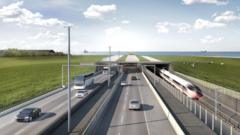
The construction of an extraordinary tunnel is underway, designed to bridge Denmark and Germany beneath the Baltic Sea. Spanning 18 kilometers (11 miles), the Fehmarnbelt tunnel will set the record as the longest pre-fabricated road and rail tunnel in the world, fundamentally transforming travel dynamics between Scandinavia and mainland Europe.Situated at the northern entrance on Lolland Island, the construction site covers over 500 hectares (1,235 acres) and hosts a harbor alongside a factory dedicated to manufacturing "elements" of the tunnel. Each element, measuring 217m (712ft) long and 42m wide, utilizes reinforced steel encased in concrete, showcasing a unique construction approach that involves piecing the elements together underwater.Henrik Vincentsen, Chief Executive of Femern, the state-owned Danish company overseeing the tunnel's construction, boasts about the record-breaking nature of the project. Unlike traditional underwater tunnels that dig through bedrock, this initiative employs a method where 90 individual elements will be immersed on the seabed and assembled like Lego pieces.The project, with an estimated cost of €7.4 billion ($8.1 billion), is primarily funded by Denmark, alongside a €1.3 billion contribution from the European Commission. As a significant infrastructure venture, it aligns with broader EU objectives to bolster travel links while minimizing air travel emissions. Once operational, travel between Rødbyhavn in Denmark and Puttgarten in Germany will only take 10 minutes by car or seven minutes by train, a stark contrast to the current 45-minute ferry ride. Additionally, it will reduce travel time between Copenhagen and Hamburg from five to 2.5 hours, providing an essential transport corridor for both passengers and freight.Beneath the looming cranes, senior construction manager Anders Gert Wede provides a tour of the future tunnel. Comprising five parallel tubes—two for rail and two for road traffic, along with a maintenance corridor—the tunnel emphasizes safety and efficiency. The robust design ensures that enormous elements, each weighing over 73,000 tonnes, are carefully lowered into a trench dug out on the sea floor with utmost precision.Denmark's position at the Baltic Sea's entrance poses unique engineering challenges, prompting the choice of a submerged tunnel over a bridge, which would risk disrupting traffic due to strong winds and shipping incidents. The initial proposal faced opposition from ferry operators and conservation groups concerned about ecological impacts on local habitats. However, legal rulings in favor of the project have cleared the way for construction to advance.Future operations of the tunnel foresee a significant surge in travel, predicting over 100 trains and 12,000 cars daily, with revenue from toll fees covering construction loans over approximately 40 years. The local community in Lolland, historically one of Denmark's struggling regions, eagerly anticipates the economic uplift as businesses are expected to thrive due to enhanced transport links. As Wede reflects, the community has waited long for this transformative project, which promises to boost jobs, tourism, and overall economic development once the tunnel opens in 2029.