The World Trade Organization (WTO) has issued a stark warning regarding the future of global trade, projecting a decline in trade volume this year as a direct result of tariffs imposed by US President Donald Trump. The organization highlighted the potential for "severe downside risks," including retaliatory tariffs and prevailing political instability, which could exacerbate the downturn in global trade of goods.
The WTO's report indicates that trade in North America may suffer the most, with predictions of a decrease exceeding 10% in that region alone. Ngozi Ikonjo Iweala, WTO’s Director-General, expressed concern over the growing "decoupling" between the US and China, a trend that is proving increasingly troubling for the global economy.
Initially, the WTO anticipated that global goods trade would grow by 2.7% by 2025; however, this outlook has shifted dramatically, and the new forecast indicates a potential drop of 0.2% instead. Chief economist Ralph Ossa emphasized that trade policy uncertainty could severely stifle trade flows, reduce exports, and ultimately weaken economic performance.
Trump’s tariff policies began with a baseline tariff of 10% on a wide range of foreign imports that took effect on April 5, with certain exemptions in place. In contrast, China now faces even steeper tariffs, totaling up to 145% on most of its products sent to the US.
This shift in trade dynamics has already created ripples in the stock market, highlighted by a decline in key indexes following the recent uncertainty surrounding the tariffs. Nonetheless, the WTO remains optimistic that some regions, such as Asia and Europe, may experience minimal growth in both imports and exports this year, contributing positively to the overall trade landscape.
Notably, this report also includes the first forecast concerning services trade, an area where trade relates to services rather than tangible goods. The WTO predicts that services trade will witness a growth of 4% by 2025, albeit slightly less than previously estimated.
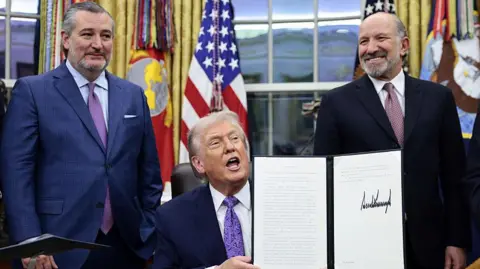
Since assuming the presidency, Trump has made numerous tariff-related announcements, suggesting that these taxes would promote American production, increase tax revenue, and attract significant investment into the US economy. Critics argue that while rejuvenating domestic manufacturing sounds appealing, the complexities involved in reverting production to US soil could take years, leaving the economy vulnerable in the meantime.
Moreover, Trump's unpredictable tariff strategies have led to abrupt policy changes, such as his recent decision to impose a 90-day pause on tariffs for many trading partners, except for China, following growing political and market pressure. Recently, the governor of the Bank of England warned that such tariffs could adversely affect UK consumers’ financial well-being, reflecting broader concerns regarding the ripple effects of US trade policies on international economies.