In brief
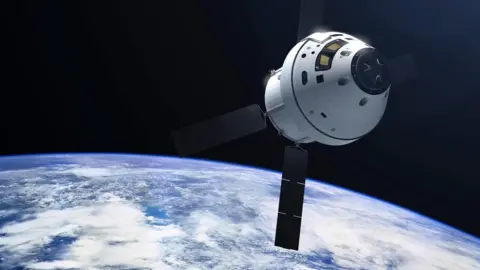
The Orion spacecraft from NASA's Artemis II mission has successfully performed its translunar injection, propelling the crew beyond Earth's orbit towards the Moon. This historic flight marks the first human journey into deep space since the Apollo program and aims to showcase humanity's capabilities in space exploration.
The crew of the Artemis II mission has officially departed from Earth’s orbit, as their Orion spacecraft executed a crucial engine burn propelling them towards the Moon. The operation, known as the translunar injection (TLI), lasted five minutes and 55 seconds and was reported to have gone ‘flawlessly’ by NASA’s Dr. Lori Glaze.
Upon departing, Canadian astronaut Jeremy Hansen expressed that the crew was ‘feeling pretty good up here on our way to the Moon’. This mission positions Artemis II on a unique trajectory that will take the astronauts to the far side of the Moon, marking the first time humans have ventured beyond Earth's orbit since 1972.
As they traveled further from Earth, viewers could witness the planet shrinking into a small dot in the distance. Hansen shared an emotional sentiment, acknowledging the hard work and dedication of everyone involved in the mission. He stated, ‘Humanity has once again shown what we are capable of,’ emphasizing the hopes resting on this journey.
After a day of checking systems in a higher orbit, the spacecraft finally received the go ahead for one final engine burn—a pivotal move towards the lunar mission. This burn significantly increased the speed of the Orion capsule, allowing it to cover 4,700 miles (7,600 km) beyond the Moon, potentially surpassing the distance record set by Apollo 13 in 1970.
NASA reassured safety protocols, stating that even after TLI, the crew could still make a U-turn in case of an emergency, allowing for a safe return home. The team has conducted extensive simulations to prepare for any unforeseen issues.
Excitingly, as they move further into space, the astronauts are set to witness a total solar eclipse on the sixth day of their mission, providing stunning views of the Moon obscuring the Sun. Throughout the journey, this mission aims not only to explore further than ever before but also to pave the way for future endeavors in lunar landing and beyond.