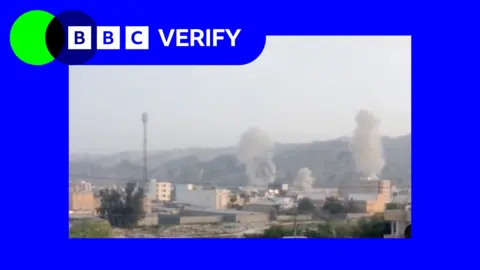
Multiple weapons experts have disputed a US claim that Iran may have been responsible for a deadly strike on the town of Lamerd on the first day of the war. Six experts - who examined footage of the strike and all commented independently - contested the US suggestion that it was an Iranian missile, citing the missile's visual features, the way it exploded, its trajectory, and the number of strikes in the area as the basis for their analysis. Iranian officials have reported that 21 people, including four children, were killed in the attacks.
BBC Verify's initial report suggested a US Precision Strike Missile may have been employed. Following this, the US Central Command (Centcom) countered claims claiming the missile was likely an Iranian Hoveyzeh cruise missile. They stated that US forces do not target civilians, attributing more than 300 Iranian attacks on civilian locations in neighboring countries.
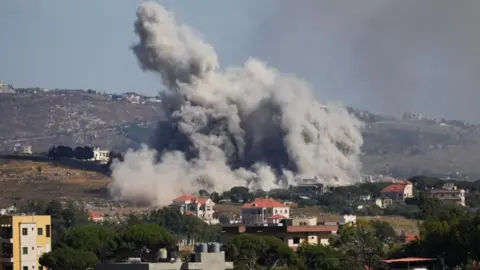
The missile in question appears in CCTV footage that was geolocated and authenticated, showing a munition exploding above a residential area. Defense analysts voiced skepticism over the possibility of multiple Iranian missiles malfunctioning over the same area simultaneously. This explosion characteristic aligns with the airburst feature of a PrSM, which maximizes impact over a broader area. Lockheed Martin describes the PrSM as containing fragments that detonate optimally, increasing lethality.
The strike indicates a higher technical sophistication than known Iranian munition capabilities. Newly published footage confirms multiple strikes hitting a sports hall, residential area, and nearby educational site, leading to questions regarding the alignment of military operations with respect to civilian populations. Initial assessments suggest the intended targets may have been military structures, raising concerns about compliance with international humanitarian law and civilian safety.
BBC Verify's initial report suggested a US Precision Strike Missile may have been employed. Following this, the US Central Command (Centcom) countered claims claiming the missile was likely an Iranian Hoveyzeh cruise missile. They stated that US forces do not target civilians, attributing more than 300 Iranian attacks on civilian locations in neighboring countries.
The missile in question appears in CCTV footage that was geolocated and authenticated, showing a munition exploding above a residential area. Defense analysts voiced skepticism over the possibility of multiple Iranian missiles malfunctioning over the same area simultaneously. This explosion characteristic aligns with the airburst feature of a PrSM, which maximizes impact over a broader area. Lockheed Martin describes the PrSM as containing fragments that detonate optimally, increasing lethality.
The strike indicates a higher technical sophistication than known Iranian munition capabilities. Newly published footage confirms multiple strikes hitting a sports hall, residential area, and nearby educational site, leading to questions regarding the alignment of military operations with respect to civilian populations. Initial assessments suggest the intended targets may have been military structures, raising concerns about compliance with international humanitarian law and civilian safety.