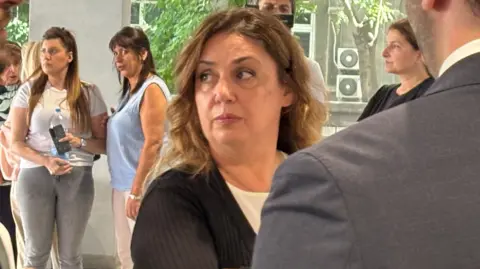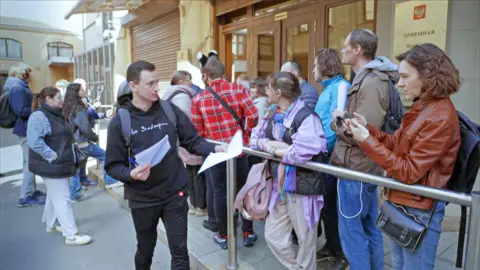
In recent weeks, Russians have been seen queuing outside the presidential administration office, submitting petitions to President Putin that call for an end to the ongoing crackdown on internet freedoms. Amidst increasing government control, citizens express fear and frustration over restrictions that limit access to global messaging apps and cause widespread disruptions to mobile internet services. Petitioning is a legal avenue, yet in an authoritarian context, it puts individuals at risk.
Security officers, visible from the street, monitor and record the petitioners, creating a tense atmosphere where people like Yulia, a local entrepreneur, admit to feeling scared as they push back against the state’s tightening grip. She recalls her experience with recent internet disruptions that made it difficult for her catering business to operate.
The government's justification for the crackdown cites public safety and claims of national security related to ongoing conflicts, yet many question the legitimacy of such measures. The Kremlin increasingly promotes its own state-approved applicant, MAX, in a push for a 'sovereign internet,' which raises further suspicions among the public regarding intentions behind these efforts.
Activists and ordinary citizens alike recount experiences of failed protests, denied permissions, and other challenges posed by state authorities, suggesting that resistance is met with increased surveillance and repression. The palpable discontent is met with silence from the government, as it continues to prioritize authoritarian controls over freedoms, driving citizens deeper into a cycle of adaptation in reaction to changing internet landscapes.
As everyday internet access becomes increasingly constrained and state-sanctioned information dominates, Russians must navigate a new reality that feels reminiscent of historical censorship and isolation. The sentiments of uncertainty that resonate throughout the country reflect a populace that is beginning to connect their daily struggles with wider political and economic grievances. The situation in Russia marks a critical juncture, as citizens grapple with the implications of digital restrictions, paving the way for potential unrest in the future.
Security officers, visible from the street, monitor and record the petitioners, creating a tense atmosphere where people like Yulia, a local entrepreneur, admit to feeling scared as they push back against the state’s tightening grip. She recalls her experience with recent internet disruptions that made it difficult for her catering business to operate.
The government's justification for the crackdown cites public safety and claims of national security related to ongoing conflicts, yet many question the legitimacy of such measures. The Kremlin increasingly promotes its own state-approved applicant, MAX, in a push for a 'sovereign internet,' which raises further suspicions among the public regarding intentions behind these efforts.
Activists and ordinary citizens alike recount experiences of failed protests, denied permissions, and other challenges posed by state authorities, suggesting that resistance is met with increased surveillance and repression. The palpable discontent is met with silence from the government, as it continues to prioritize authoritarian controls over freedoms, driving citizens deeper into a cycle of adaptation in reaction to changing internet landscapes.
As everyday internet access becomes increasingly constrained and state-sanctioned information dominates, Russians must navigate a new reality that feels reminiscent of historical censorship and isolation. The sentiments of uncertainty that resonate throughout the country reflect a populace that is beginning to connect their daily struggles with wider political and economic grievances. The situation in Russia marks a critical juncture, as citizens grapple with the implications of digital restrictions, paving the way for potential unrest in the future.