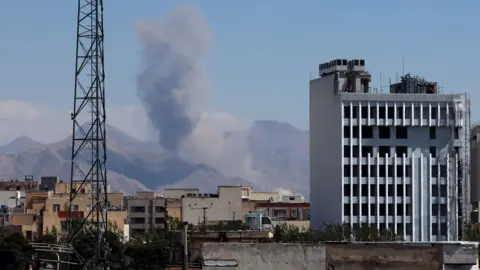
The clock is ticking on President Donald Trump’s threat to wipe out much of Iran's civilian infrastructure if the country doesn’t strike a deal by Tuesday evening in the US.
But Trump has backed himself into a corner with threats that the US military cannot feasibly carry out in one fell swoop, military experts and analysts have stated. They warn that a new round of attacks, regardless of size, is unlikely to compel the Iranian regime to agree rapidly to a ceasefire.
Trump vowed to destroy every bridge and power station in Iran within four hours if a deal isn't reached by 20:00 EST (00:00 GMT Wednesday). He further escalated his rhetoric by stating that a whole civilization will die if Iran does not comply by his deadline.
The implications of such threats amount to an unprecedented stance from a US president, with experts suggesting targeting civilian infrastructure could be construed as a war crime, with some interpretations bordering on inciting genocide. However, Trump dismissed these legal concerns during a press conference.
Additionally, experts pointed out that the US simply cannot destroy every bridge in a country the size of Iran within a few hours. Given that Iran is roughly a third of the size of the continental US, the challenge is immense, they noted.
To meet this threat literally would be an absolute herculean task. And would it have the desired strategic effect? questioned a former senior US defense official.
While a large-scale attack on Iran’s power sector is technically more feasible, the majority of Iran's power plants and refineries are clustered in three coastal provinces. Striking these could potentially cripple the Iranian government’s control over oil revenue, according to Miad Maleki, a former senior US treasury official.
Meanwhile, Pakistan's Prime Minister Shehbaz Sharif has requested the US to extend the deadline by two weeks, suggesting it would provide more time for negotiations. The proposal may help facilitate dialogue between the US and Iran.
In recent military developments, US airstrikes have targeted Iranian military assets, with Vice President JD Vance commenting that these actions don’t signify a shift in strategy. However, he warned that the US still possesses “tools” they haven't yet chosen to deploy.
As the deadline looms, the Iranian regime’s responses suggest resilience against US pressure, reflecting a broader struggle for survival amid geopolitical conflicts.