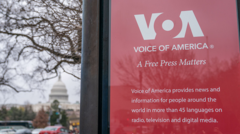
Trump has signed an executive order that threatens the operational integrity of Voice of America (VOA), an independent, federally funded news organization established in 1942 to counter Nazi and Japanese propaganda during World War II. The order specifically targets its parent organization, the US Agency for Global Media (USAGM), which oversees several other entities, including Radio Free Europe and Radio Free Asia. These organizations were originally formed to counteract communism but serve broader purposes today.
As a result of this order, VOA's director, Mike Abramowitz, announced that he and nearly all of the organization's 1,300 employees have been placed on paid leave, putting VOA's critical mission in jeopardy. "In today's environment, with adversaries like Iran, China, and Russia investing heavily in disinformation campaigns against the U.S., this action could not come at a worse time," Abramowitz stated.
No clear explanation has been provided by the Trump administration regarding these operational changes, and reports suggest that the status of the stations remains uncertain. Employees were informed via email that budgetary constraints would mean there would be no funds to pay freelancers and international contractors. Additionally, several federal grants supporting Radio Free Asia and Radio Free Europe/Radio Liberty have been terminated.
Serving over 400 million listeners globally, VOA is often compared to Britain's BBC World Service, which operates with partial government funding. The impact of these recent cuts follows Trump’s longstanding criticism of VOA, which he has accused of bias against his administration.
Elon Musk, an advisor to Trump, has publicly supported proposals to shut down the organization on his social media platform X. Under Trump, funding for various federal programs, including those addressing homelessness and supporting museums, has also faced significant cuts. Amid these changes, critics are increasingly concerned about threats to independent journalism and the integrity of global news narratives at a time when misinformation is rampant.
Established with a mission to provide unbiased information, VOA has seen its role evolve since its inception, particularly after legislation in 2013 permitted domestic broadcasts. With the recent order, the future efficacy and independence of this storied institution remain uncertain, risking a shift in how global audiences receive news and information from the United States.