In brief
In the southern Netherlands, Moerdijk, a close-knit fishing community, finds itself at risk of obliteration by an energy project aimed at supporting the country's transition to renewable energy. The village's prime location has made it a target for new substations, raising concerns among residents about the loss of their homes and heritage. Local voices echo a sentiment of sacrifice as they navigate the uncertain future dictated by the government’s infrastructure needs.
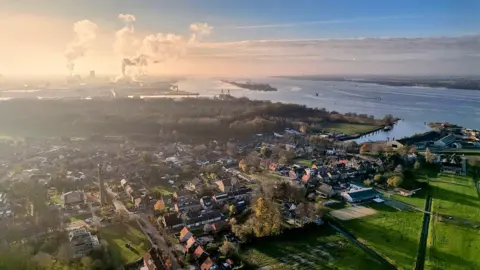
In the south of the Netherlands, beside a wide estuary, a village of around 1,100 people is likely to disappear from the map as the Dutch government prioritizes energy infrastructure development. Moerdijk, a small fishing community 34 km south of Rotterdam, is viewed as a prime site for high-voltage substations needed to connect electricity from expanding offshore wind farms to the national grid. The government argues that land is scarce, and Moerdijk’s advantageous location near ports and existing powerlines makes it an ideal candidate for such projects. As a result, residents face imminent threats of home demolitions, raising significant concerns about their future.Local fishmonger Jaco Koman illustrates this sentiment as he reflects on the impact of potentially losing not only his business but his home too. 'You go to bed with it and you wake up with it,' he laments. The shock the community felt upon learning about the plans was overwhelming, with many adults now contending with the emotional weight of loss.Despite the urgent need for renewable energy in the Netherlands, villagers argue that there are alternatives, such as situating infrastructure further out at sea rather than in near proximity to existing communities. Andrea, a local grocery shop owner, articulates fears of losing her family home and even shares concerns over the village cemetery where generations of her family rest.The ongoing debate in Moerdijk exposes a broader struggle within the Netherlands, where limited land means competing demands for housing, agriculture, and now renewable energy. The mayor emphasizes that local sacrifices might be seen as necessary to preserve other communities, while many residents question why their village must bear the brunt of national policy.As decisions loom about Moerdijk's fate, the residents are not just facing the potential of uprooting their lives but are witnessing a confrontation between traditional communities and the urgent mandates of a country transitioning to greener energy sources.